
Your needs, this model
Does it fit your priorities?
Is the CPT-525 a two-slice toaster, and does it offer a one-slice setting?
Cuisinart identifies the CPT-525 as a two-slice toaster and lists a separate Single Slice control. That makes the batch size and the named one-slice option visible, but the page does not explain exactly how the one-slice cycle uses the two openings. Do not mistake it for a four-slice machine.
Explore this need in the finder →Are Bagel and frozen-food controls both listed for the CPT-525?
Yes. The current U.S. product page lists a True Bagel mode and a Defrost control. It also describes QuickView and several bread presets. The exact user sequence, orientation and food limits are not established because an instruction booklet was not exposed in the source view checked; confirm the CPT-525 manual before relying on the control behavior.
Explore this need in the finder →Will an unusually long slice or my counter fit the CPT-525?
The product page calls its openings extra-long and compares their size with the older CPT-160, but gives no slot measurements, maximum slice dimensions or outside body dimensions. Measure the appliance and your usual bread, and check an exact-model manual before treating the marketing comparison as a fit guarantee.
Explore this need in the finder →The CPT-525 is Cuisinart's two-slice motorized digital toaster, not another finish of its conventional lever models. Its product page describes a one-touch lift, elongated openings and a control panel built around bread presets, a shade choice and several cycle adjustments. That is a clearly different documented workflow from a toaster where you push down a carriage lever and wait. The maker's page is unusually feature-rich, but it is not an independent performance test: no browning results, cycle times or noise measurements are established here.
A motorized routine with several layers of control
The product page lists six bread categories and seven shade levels, alongside a memory feature that stores up to four personalized combinations. It also names a single-slice setting, a cancel control, a defrost option, a Bagel mode, a mid-cycle view feature and a separate thirty-second addition. That gives the CPT-525 more than a simple shade dial: a user can select a bread profile, adjust the shade and then choose a specific cycle action. The source does not provide the booklet that would explain the exact button order, how a saved setting is recalled or what the display shows during each stage, so these details should be checked in the instructions for the exact unit.
“Extra-long” is useful context, not a bread-size guarantee
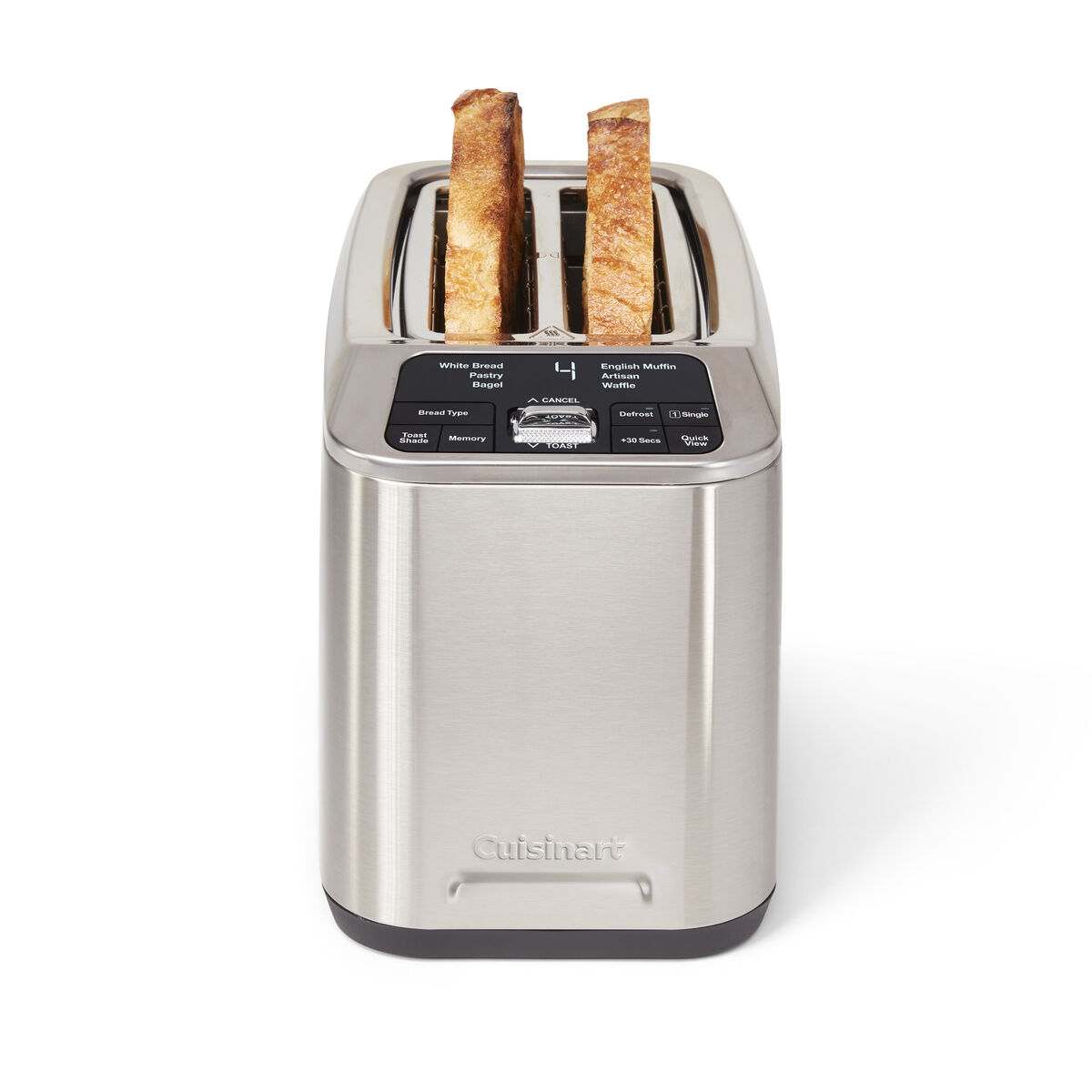
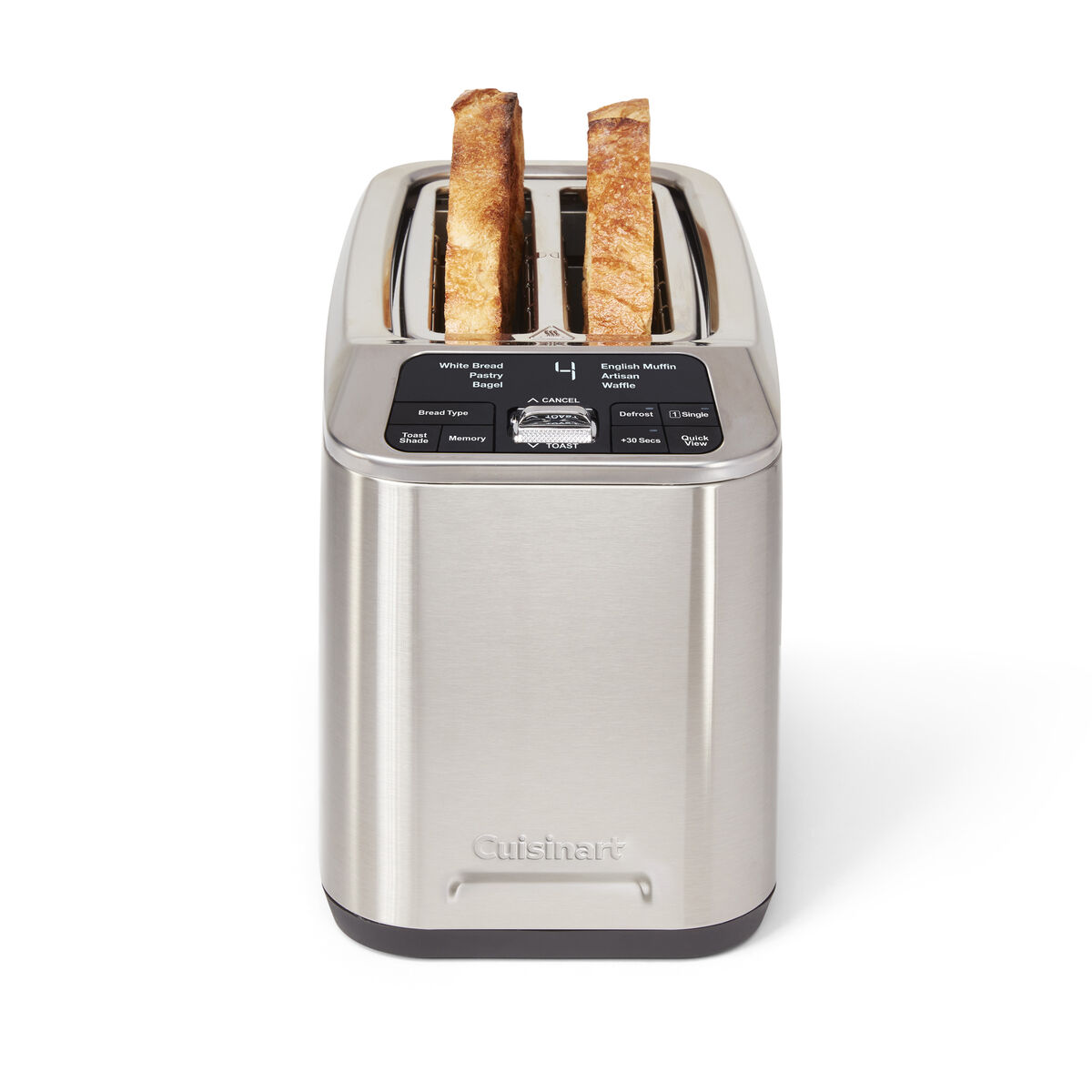
Cuisinart describes the two openings as extra-long and compares their size favorably with its older CPT-160 model. That is a relative marketing statement, not a published opening width, depth or maximum slice length. The product photograph shows two long top slots, but a photograph cannot establish whether a thick homemade slice, a long piece of rye or a wide bagel half will fit without pinching or sticking. If a particular loaf is the reason for choosing this toaster, check its dimensions against a real opening or obtain exact-model measurements before buying. The word “long” does not establish four-slice capacity: Cuisinart identifies this as a two-slice arrangement.
Bagel and defrost are named controls
The page lists both a Bagel function and Defrost, which makes the CPT-525 a plausible candidate for someone who wants to choose those tasks rather than rely on an undocumented automatic frozen-food sensor. Cuisinart describes the Bagel setting as treating the cut side differently from the outer crust. That is the manufacturer's description, not a result reproduced in testing, and the page does not publish the exact bread orientation or a frozen-bagel sequence. The manual was not exposed in the page view checked, so confirm the instruction booklet before assuming which face goes where or whether two settings can be combined in one cycle.
QuickView and extra time solve different problems
The QuickView control is described as letting the user inspect toast partway through without ending the run. The added-time button is a separate action for a cycle that needs more time. These are different conveniences: a progress check does not prove that the shade sensor is more accurate, and adding time does not guarantee an even result. In the current fact set, the CPT-525 qualifies for the review's mid-cycle-inspection and added-time questions because the U.S. product page names both functions. Exact operating steps remain unknown without the booklet. This distinction is also visible in the researched CPT-1600 assessment, which describes a different manual-lever arrangement and its own control set; the two Cuisinart model numbers should not be treated as interchangeable packages.
Two slices can be a benefit or a bottleneck
The stated capacity suits small batches better than a four-slice routine, but a household that regularly needs several pieces at once may need consecutive cycles. The listed Single Slice control gives one-piece users a named option; the page does not explain whether this changes time, power distribution or slot use. The memory feature may reduce repeated setup if the same bread and shade return often, but its practical value depends on how easily the settings can be saved and selected. Those are useful questions to answer from the booklet rather than assumptions from the feature names.
The largest fit and ownership questions are still open
The visible specification rows do not give the appliance's width, depth or height, the slot aperture, rated wattage, supply voltage or frequency. The page shows a numerical weight without a unit, so it is not presented here as pounds. Cuisinart lists a slide-out crumb tray, cord storage and a three-year limited warranty, but no exact-model care steps or full warranty conditions were available in the source material reviewed. Before ordering, confirm the model number on the carton, obtain the CPT-525 manual, measure the actual body and openings, and read the current warranty terms for the seller and unit. A compact-footprint description is not a dimensional specification.
Who should keep it on a shortlist?
The CPT-525 is most relevant when a two-slice batch, motorized lift and selectable bread-and-shade controls are more important than a documented counter footprint. Its exact-model image and product listing support the control layout and stainless-steel identity; they do not establish consistent browning, durability or fit for every artisan loaf. Shoppers who need a proven maximum slice dimension, known electrical rating, detailed safety setup or measured body size should treat those as unanswered checks rather than infer them from the advertising. This is a feature-based research assessment of the U.S. CPT-525 page, not a claim of ownership or hands-on use.
Key specifications
Key details at a glance
| Capacity | 2 slices per cycle |
|---|
Use the exact model’s instructions for operating limits, supplied equipment and version differences.
Sources for this review
Sources for this assessment
Compare the routine, not just the control panel.
Use the finder for combinations of capacity, features and counter limits, then check each exact model's review and instructions.