
Your needs, this model
Does it fit your priorities?
How many slices can the CPT-1600 toast in one cycle?
Cuisinart identifies the CPT-1600 as a two-slice toaster. Its Single control is for adjusting a one-slice cycle; it does not turn the appliance into a four-slice model. If four pieces per batch are important, compare a separately identified four-slice configuration.
Explore this need in the finder →Does the CPT-1600 have a frozen-bread setting?
Yes. Its booklet describes a separate Defrost button for frozen bread, waffles, pancakes, French toast and bagels. The directions say to set the shade, lower the carriage and then select Defrost. Automatic frozen sensing without pressing a button is not documented for this model.
Explore this need in the finder →Can I check the toast during a cycle without cancelling it?
The High-Lift QuickView function lets the user raise the lever to view browning and release it so the cycle continues. This is a manual inspection feature, not a measured toast-color guarantee or a motorized lowering system.
Explore this need in the finder →Does it offer separate browning controls for each pair of slots?
The two-slot CPT-1600 booklet shows one browning dial and no separate left/right pair settings. It therefore does not meet a requirement for independently set pairs; its Single button is a separate adjustment for a one-slice cycle, not a second browning dial.
Explore this need in the finder →This assessment covers the exact U.S. Cuisinart CPT-1600, listed as the 2-Slice XL Slot Stainless Steel Toaster. It is a document-based review of the manufacturer's product information and instruction booklet, not a hands-on test. The combination that stands out on paper is a two-slice capacity, an extra-large-slot design, a useful set of specialty controls, and a published 12-by-7.25-by-8-inch body. The gaps matter too: Cuisinart does not publish the slot opening measurements or a maximum bread length on the sources reviewed, so “XL” should not be treated as a guaranteed fit for any particular loaf.
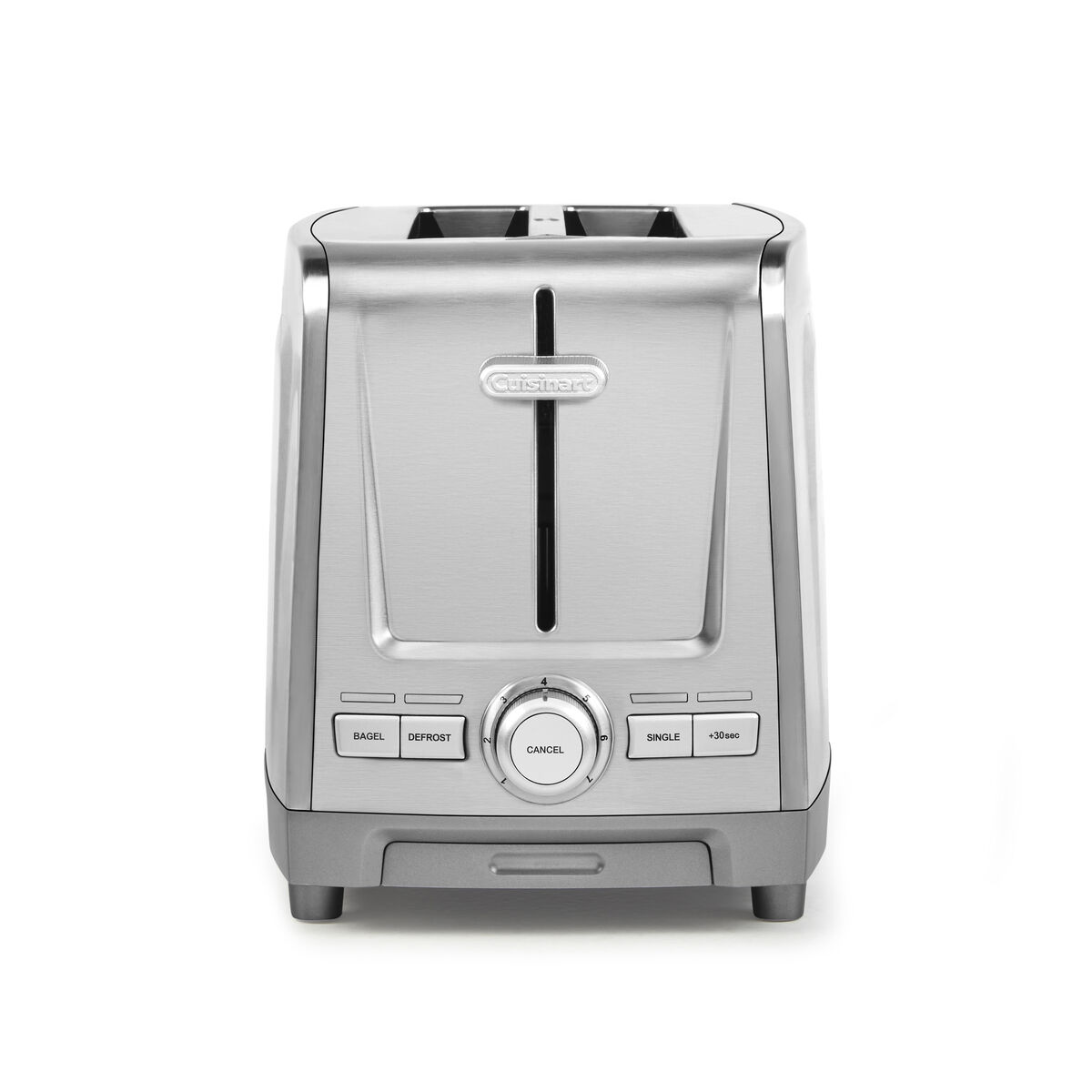
Two slices, with room for more than standard bread
The product page calls this a two-slice XL-slot toaster and says its extra-long slots are larger than standard. The instruction booklet describes dual extra-large slots, but neither source supplies a numerical slot width, depth or maximum food length. That is the key fit boundary: the published outside dimensions can help you plan the counter, but they cannot establish whether a tall, wide or unusually shaped slice will clear the slot guides. Measure the bread you use and check the exact instructions; the manual says food should fit freely and warns against forcing it into a slot. The external dimensions are listed as 12 inches long by 7.25 inches wide by 8 inches high. In the usual front-facing placement, that suggests a 7.25-inch side-to-side width and 12-inch front-to-back depth, but check the product's orientation against your counter before using those numbers as a fit guarantee. Body dimensions also do not include the space needed to reach the controls, remove the front crumb tray, or route the cord. Cuisinart's manual says not to operate the toaster under a wall cabinet or inside an appliance garage. It gives no numerical side or overhead clearance here, so a tight shelf is a reason to consult the complete manual and assess the setup rather than assume a safe gap.Controls are practical, not a promise of uniform toast
One browning dial offers settings 1 through 7, which the booklet groups as light, medium and dark ranges. A dedicated Bagel control reduces heat on one side of the slot; Cuisinart's diagram says to place the cut side away from the center of the pair. Defrost runs a longer cycle to thaw and toast frozen food, while the Single setting adjusts time and intensity for one slice. These are separate, documented operating choices, not evidence of independently adjustable left and right slots. There is one shared shade dial for this two-slot arrangement. The +30Sec button adds thirty seconds, and the High-Lift QuickView lever temporarily raises toast for an in-cycle look before it is released to continue. Cancel stops the cycle and raises the carriage. These controls can be useful when a user wants extra time or an inspection pause, but the documentation does not establish a particular shade result on every bread type. Cuisinart itself notes that moisture, freshness, thickness and uneven surfaces affect the time needed; very thick bread may need two cycles. No independent browning, speed, noise or durability measurement is represented in this review.Cleaning and everyday limits
The front crumb tray slides out for emptying. The instruction booklet says to unplug the unit and let it cool before cleaning, wipe the housing with a clean damp cloth, replace the crumb tray before use, and avoid putting hard or sharp tools into the slots. It also advises against buttered bread, warns that toaster-pastry filling can become hot before its surface browns, and says to use the lightest setting for toaster pastries. Those cautions are more useful for planning a routine than generic claims that a toaster is easy to clean. The booklet describes a polarized plug and says the product is designed for 120-volt outlets. Neither the current U.S. product page nor the captured instruction booklet states a wattage or exact cord length; those figures remain unknown here. The product page lists a three-year limited warranty, while the booklet restricts its stated coverage to qualifying U.S. household purchasers who buy in original sealed packaging from Cuisinart or an authorized reseller. Read the full warranty and verify that any specific unit, seller and purchase satisfy its terms.Who should compare it—and what to check
The CPT-1600 is worth comparing if two slices per cycle are enough and you value a manual, extra-large-slot layout plus Defrost, Bagel, Single, +30Sec and QuickView controls. If four pieces in one batch are essential, Cuisinart's same U.S. toaster listing also shows a CPT-1800 as a four-slice XL-slot model; that name signals a different capacity/layout question, not a claim that its controls or dimensions match the CPT-1600. If you need motorized lowering, the manufacturer lists a different CPT-525 as a 2-slice motorized digital model, which should be evaluated from its own manual and package details. Before choosing a particular offer, confirm that its label says CPT-1600, that it is the U.S. stainless-steel configuration, and that the package and warranty match your expectations. Measure the countertop in the stated orientation, consider the manual's cabinet warning, leave room for the tray and plug, and compare your actual bread against the unreported slot opening. Price, stock, seller quality, user experience and toast performance are not established by these sources.Sources: Cuisinart U.S. CPT-1600 product page and its CPT-1600 instruction booklet. The category comparison names come from Cuisinart's U.S. toaster listing. CPSC's toaster recall index was checked as a limited model-specific screen; no CPT-1600 notice surfaced in the search performed. That is not a safety certification or a complete recall determination.
Key specifications
Key details at a glance
| Capacity | 2 slices per cycle |
|---|---|
| Body width | 7.25 in |
| Body depth | 12 in |
| Body height | 8 in |
| Supply voltage | 120 V |
Use the exact model’s instructions for operating limits, supplied equipment and version differences.
Sources for this review
Sources for this assessment

Compare the routine, not just the control panel.
Use the finder for combinations of capacity, features and counter limits, then check each exact model's review and instructions.