
Your needs, this model
Does it fit your priorities?
Can the CPT-142P1 set different browning levels for separate slot pairs?
Yes. The linked CPT-142 booklet says the left-side controls and lever operate the left pair and the right-side controls and lever operate the right pair. It is pair-level control, not a separate dial for each of the four slots.
Explore this need in the finder →What happens when I use Bagel, Defrost or Reheat?
The booklet says Bagel adds time for thicker bread, Defrost first warms frozen bread and then toasts it, and Reheat warms bread without browning. For a frozen bagel, choose a shade, lower the lever, then press Defrost and Bagel; this is an instruction, not a browning or size guarantee.
Explore this need in the finder →Will a thick or unusually long piece of bread fit?
The maker lists 1½ inches of slot width but publishes no slot length, depth or maximum food dimension in the reviewed page and booklet. The manual says to halve bagels, never force food between the guide wires and allow that very thick pieces may need two cycles. Check your own bread against the actual opening.
Explore this need in the finder →Does the compact body fit beneath my cabinets?
Cuisinart lists 10.7 inches wide, 10.8 inches long and 7.2 inches high. For the pictured orientation, the review represents length as depth, but verify that on the offered unit. These are not clearance dimensions: the booklet specifically says not to operate beneath a wall cabinet or in an appliance garage and gives no numeric safe spacing.
Explore this need in the finder →The Cuisinart CPT-142P1 is a current U.S. white four-slice compact toaster with four separate openings, two manual carriage levers and two left/right control groups. Its case is sold as plastic with stainless-steel accents; it is not a four-lane long-slot toaster. This assessment is based on the exact maker page and the CPT-142 instruction booklet linked from it, not on hands-on use or a browning test.
Four openings and a small shared control distinction
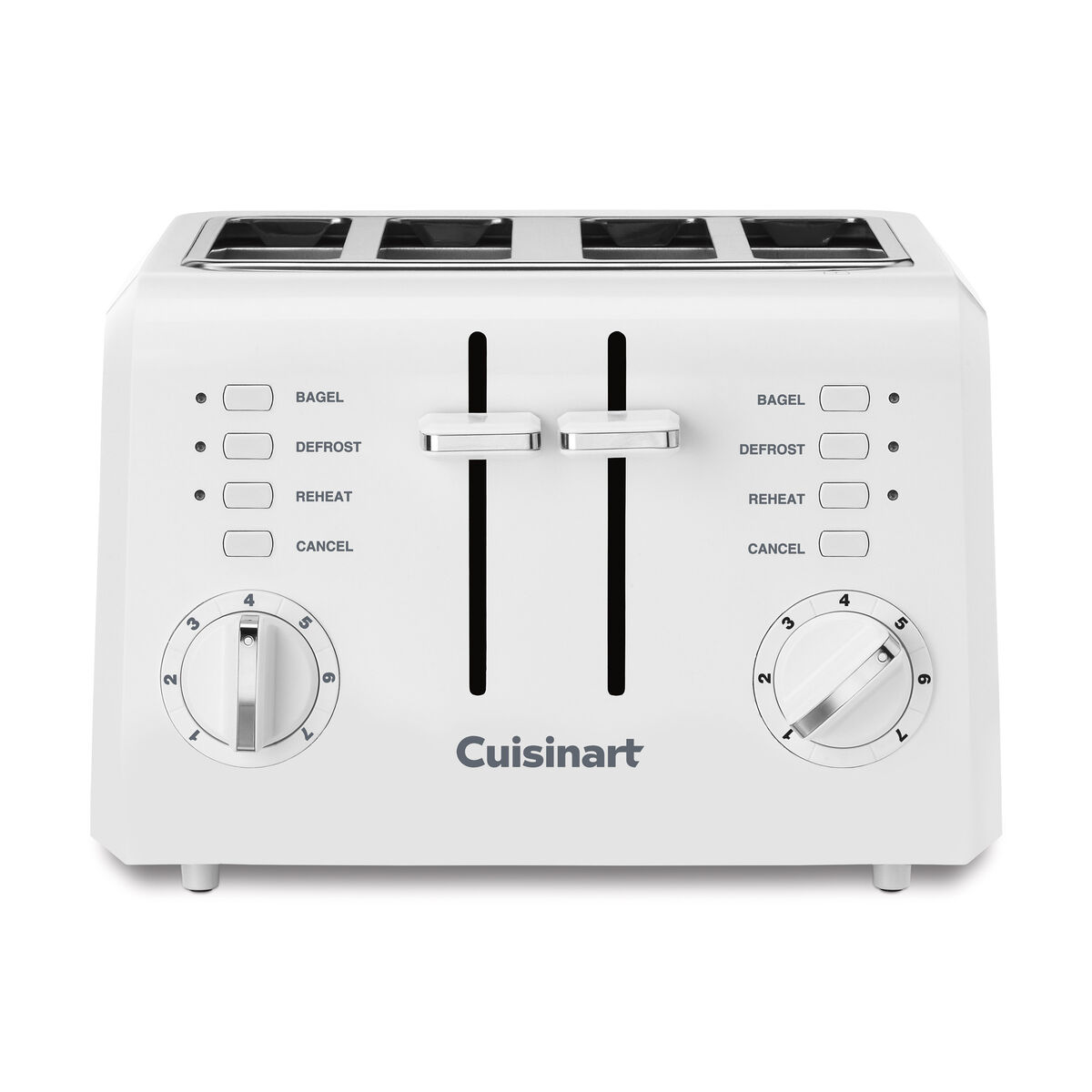
Cuisinart calls this a four-slice model, shows four separate openings, and describes room for two thick bagel halves and two bread slices in a cycle. Its manual identifies two control panels and instructs users to use the controls and carriage lever on the side being toasted. That means the left pair and right pair can use different shade settings; it does not mean each opening has its own shade dial. A four-slice count is a batch claim, not a promise about every piece of bread you own.
The maker lists each slot as 1½ inches wide. It does not publish slot length, depth, or a maximum bread dimension in the reviewed U.S. page and booklet. The four openings are not a long-slot arrangement. The manual says not to force food between the guide wires, notes that very thick pieces may take two cycles, and calls for halving bagels before toasting. For an unusually broad or tall item, compare it with the real opening rather than treating “extra-wide” or a product photo as a fit measurement.
Simple dial control, with separate Bagel, Defrost and Reheat buttons
Each pair has a seven-position browning dial, manual lever and buttons for Bagel, Defrost, Reheat and Cancel. Bagel adds time for thicker breads; it is not a sensor that detects a bagel or a dedicated extra-time button for correcting a cycle. Defrost first warms frozen bread and then toasts it, while Reheat warms bread without browning or toasting. The levers raise a finished cycle automatically, and Cancel interrupts one before it finishes.
For frozen bread, the manual says to choose a shade, lower the lever, and select Defrost. For a frozen bagel, it says to select the shade, lower the lever, then press Defrost and Bagel. Those are distinct named controls; this is not automatic frozen sensing. The book cautions that moisture, thickness and surface change timing, so its shade guide is only a starting point rather than a tested outcome. It also warns that toaster-pastry filling can heat before the outside browns and says not to toast buttered bread or pastries with fillings or frosting.
Compact body, but dimensions do not establish a safe spot
The exact white P1 page lists an outside body of 10.8 inches long by 10.7 inches wide by 7.2 inches high. For the front-facing image, this review represents the listed length as front-to-back depth and width as side-to-side width; verify orientation against the offered unit. These figures describe the appliance shell only. They do not add space for the cord, loading, nearby walls, a hot surface or pulling out the crumb tray.
The instruction booklet explicitly says not to operate under a wall cabinet or in an appliance garage. It gives no numerical clearance, so neither a dimension match nor the manufacturer's “compact” description is installation advice. The booklet limits the toaster to 120-volt outlets; the current U.S. product view and linked booklet do not establish wattage or frequency. Check the exact rating plate and placement instructions if either electrical details or counter space is critical.
How it differs from the other Cuisinart layouts
The CPT-640P1 is also a four-opening pair-controlled manual toaster, but its linked booklet adds five bread selections and a Single Slice function; those controls do not transfer to the CPT-142P1. The CPT-435P1 is a separate countdown-style four-slice design with its own documented interface. If a long opening matters more than serving four slots at once, the two-slice CPT-1600 is a different layout to compare, not a larger-capacity equivalent. These comparisons concern source-documented arrangements, not which toaster browns better.
Cuisinart's official discontinued records also identify the black CPT-142BK and the older white CPT-142 with this family of four-slot controls and the CPT-142-series booklet. Both are separate earlier identities covered here only for the documented shared operating layout, not as current white-P1 offers. The CPT-142BK page repeats the P1's listed body dimensions; the older CPT-142 page shows only a generic “INCH” dimension marker, so those P1 measurements must not be transferred to that older white model. Exact images for all three identities remain distinct.
Cleaning, replacement parts and remaining checks
The manual says to unplug the toaster and let it cool before cleaning, remove and wipe the slide-out crumb tray, then put the tray back before use. It says not to use abrasives or sharp utensils inside the slots and to leave other servicing to an authorized representative. Cuisinart lists a limited three-year warranty on the product page; the booklet limits the described terms to normal household use and eligible U.S. purchases, so confirm coverage for the exact seller and unit.
The product page links a CPT-142CT replacement tray, but the maker's tray page names compatible models CPT-142 and CPT-142BK, not the current CPT-142P1 suffix. Do not treat a product-page link or shared family number as confirmed suffix-level part fit; ask Cuisinart or verify the exact unit before ordering. The sources also leave maximum food dimensions, numeric clearance, power draw, frequency, verified test performance and offer-specific condition unresolved.
Read the Cuisinart CPT-142P1 product page and its linked CPT-142 instruction booklet for the exact version and operating directions.
Key specifications
Key details at a glance
| Capacity | 4 slices per cycle |
|---|---|
| Body width | 10.7 in |
| Body depth | 10.8 in |
| Body height | 7.2 in |
| Supply voltage | 120 V |
Use the exact model’s instructions for operating limits, supplied equipment and version differences.
Sources for this review
Sources for this assessment
- Cuisinart U.S. 4-Slice Compact Toaster exact CPT-142P1 product page
- Cuisinart current U.S. toaster category, 12 of 12 toaster entries
- Cuisinart CPT-142 Series Compact 4-Slice Toaster booklet directly linked from the CPT-142P1 page
- Official Cuisinart White CPT-142P1 product image linked from the exact U.S. page
- Cuisinart CPT-142CT replacement crumb tray product page linked from the exact toaster page
- U.S. CPSC public toaster recall index and limited CPT-142P1 model search

Compare the routine, not just the control panel.
Use the finder for combinations of capacity, features and counter limits, then check each exact model's review and instructions.