
Your needs, this model
Does it fit your priorities?
Can the four openings use two separate shade settings?
The exact image shows two separate dial/lifter banks aligned with two pairs of openings, and the directly linked Type T112 booklet labels a Cancel button. Its generic text does not spell out a pair-by-pair sequence, so confirm the exact unit and supplied instructions; this does not mean four independent settings.
Explore this need in the finder →Does the cool-wall description make the sides safe to touch?
The maker lists cool-wall sides, but its linked booklet also warns that accessible surfaces may be hot and instructs users not to touch hot surfaces. Treat the claim as a feature description, not a test result or safety guarantee.
Explore this need in the finder →Can I verify counter, bread and tray clearance from a published dimension?
No exact body size, slot aperture or maximum bread dimension is published. The manual calls the tray drop-down, so plan for access below it, but the necessary clearance itself is unknown; measure the unit and check your bread before considering an earlier offer.
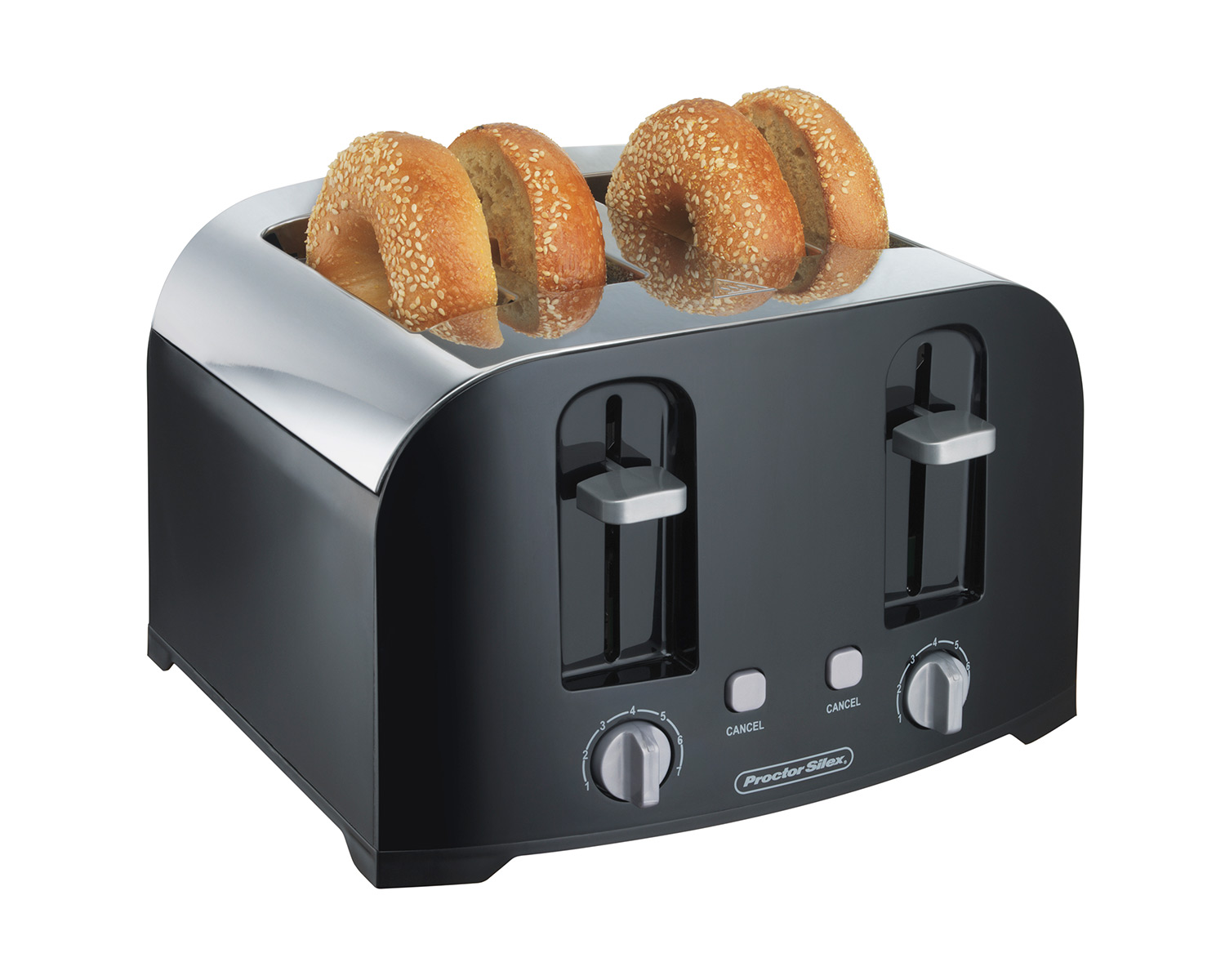
Explore this need in the finder →The Proctor Silex 24622 is an earlier U.S. four-slice Cool-Wall toaster, not a current maker offer. Its exact product page identifies model 24622, says No Longer Available, and lists Toast Boost, automatic shutoff, a shade selector, a drop-down crumb tray, cool-wall sides, cord wrap and a one-year warranty. The page-linked photograph shows a black-front, chrome-color body with four conventional openings and two separate front control stations. A directly linked booklet has a model-table row for 24622, Type T112, rated at 120 volts, 60 hertz and 1,300 watts.
A conventional four-opening layout
The image is useful for distinguishing this model from the 24610. It shows four separate openings arranged as two left/right groups, with one lifter and shade dial at each group. The 24610 instead appears in its exact photo as a four-slice model with two elongated openings. This visual difference can matter if you want the familiar four-slot arrangement, but it does not show how long, wide or deep any opening is. The maker publishes no body footprint, bread-slot aperture, maximum slice length or maximum food thickness for 24622. Use the picture for model identity, not for a fit promise.
The image also shows six numbered shade marks on each dial. Those are control positions, not calibrated temperatures or proof that the same number yields the same toast color across bread types. The linked booklet explains that the shade selector adjusts toast shade and labels a Cancel button; it does not provide a performance chart or guarantee consistent results for every slice. The separate controls are a meaningful pair-level arrangement, not four independently adjustable settings.
Pair controls and the limits of the manual
Two visible shade dials and levers are a practical feature for a household that may want to set the left and right pairs differently. The exact image supports the presence of two distinct banks, and the directly linked instructions identify a lifter, selector, drop-down tray and Cancel button. However, the booklet's operating prose is generic: it describes selecting a shade and lowering a lever, but does not narrate a detailed pair-by-pair procedure. That distinction matters if separate settings are an essential requirement. Treat the pictured banks as a good reason to compare this model, not as evidence of four separate shade controls or a tested sequence.
The page also lists Toast Boost as lifting slices higher. The booklet depicts a manually operated lifter, so this review treats it as a manual high-lift arrangement rather than an automatic boost mechanism. Automatic shutoff is listed separately, but the manufacturer does not define its trigger. The manual warns not to operate the toaster while unattended, which remains the useful operating limit regardless of the page's shutoff feature.
Cool-wall claim, modes and tray access
Proctor Silex's page calls the sides cool-wall and says they will not burn hands if accidentally touched. The linked booklet, however, warns that accessible surfaces may be hot during operation and says not to touch hot surfaces. This assessment records the maker-listed feature but does not turn it into a measured temperature result or permission to touch the sides. Keep the usual fire-safety space around the toaster, do not operate it near curtains or combustible items, and follow the exact supplied instructions.
The page and booklet do not document a dedicated Bagel or Frozen/Defrost control. Bagel-shaped food in a photo or a shade dial does not establish either program. The manual specifically warns against frozen prepared foods and toaster pastries. If a particular food or setting is essential, this record does not support treating 24622 as a match for it.
The exact page and booklet both identify a drop-down crumb tray, not a slide-out tray. The guide instructs users to unplug the toaster and let it cool before opening and cleaning the tray; it also recommends regular crumb removal. Because the tray swings down, the user needs room beneath the appliance, but the manufacturer publishes no numeric clearance. Cord wrap is page-listed, but that does not provide cord length or outlet-reach information.
Electrical rating, warranty and recall checks
The directly linked 840268301 booklet's internal table identifies exact model 24622 as Type T112 at 120 V / 60 Hz / 1,300 W. Confirm that the physical toaster's label and its included guide agree before operating an older appliance. Both the page and booklet state a one-year limited U.S./Canada warranty, but the terms depend on original purchase and proof; the sources do not establish eligibility for a used or third-party unit. The exact page's No Longer Available status is not a current marketplace-stock check.
The archived CPSC notices from 2000 and 2008 that were checked do not list model 24622, but that limited screen is not a unit-level recall clearance and cannot cover every later notice. Check the exact model and series code on the appliance against current recall information. The available documentation establishes useful identity and control details, but not whether an individual older toaster is safe, in good condition or covered by warranty.
Who should compare the 24622?
It is a useful reference for someone comparing an earlier four-opening toaster with two pictured shade-control banks, a labeled Cancel button, a drop-down tray and the maker's cool-wall claim. Its drawbacks are equally concrete: the maker says it is no longer available, no body or bread-fit dimensions are published, the manual does not spell out pair operation, and the hot-surface warning qualifies the exterior claim. A current four-slot product such as the Proctor Silex 24214PS has its own exact finish and manual limitations, so do not transfer its dimensions or control details to this code. This is a source-based assessment, not a hands-on test or a promise of even browning.
Key specifications
Key details at a glance
| Capacity | 4 slices per cycle |
|---|---|
| Listed power | 1300 W |
| Supply voltage | 120 V |
| Line frequency | 60 Hz |
| Shade control | The exact page-linked image shows six numbered shade marks; they are dial positions, not calibrated browning results. |
| Listed warranty | One-year limited U.S./Canada warranty per exact page and page-linked manual |
Use the exact model’s instructions for operating limits, supplied equipment and version differences.
Sources for this review
Sources for this assessment
- Exact U.S. Proctor Silex 4-Slice Cool-Wall Toaster, model 24622
- Directly linked Proctor Silex Use & Care booklet 840268301; internal model table lists 24622 as Type T112
- Exact page-linked official image for Proctor Silex 24622
- Saved official U.S. Proctor Silex toaster archive card for model 24622
- CPSC / Proctor-Silex 2000 toaster recall notice; bounded model-and-series screen
- CPSC / Hamilton Beach Brands 2008 toaster recall notice; bounded model-and-series screen

Compare the routine, not just the control panel.
Use the finder for combinations of capacity, features and counter limits, then check each exact model's review and instructions.