
Your needs, this model
Does it fit your priorities?
Does 22612PS use two short wide slots or a long-slot layout?
The exact U.S. page calls 22612PS a two-slice toaster with extra-wide slots, and the page-linked image shows two separate short openings. No source calls it a long-slot model or publishes an opening measurement; do not equate extra-wide with longer bread fit.
Explore this need in the finder →What outside body dimensions can be checked for the compact 22612PS?
Its exact manufacturer page lists 6.3 inches high by 5.3 inches wide by 10.1 inches deep. These values support a body-only width/depth screen; leave side clearance, cord routing, loading room and tray access to the actual counter/manual check.
Explore this need in the finder →Are extra-wide slots a dedicated bagel or frozen mode?
No. The page describes wide openings as suitable for bagels and thicker breads, but lists a manual shade selector rather than a dedicated Bagel or Frozen/Defrost button. The linked booklet's warnings still rule out some frozen prepared or nonbread foods.
Explore this need in the finder →The Proctor Silex 22612PS is an earlier compact U.S. two-slice toaster whose exact page says “No Longer Available.” The page is unusually helpful for a counter-fit screen: it lists a 6.3-inch height, 5.3-inch body width and 10.1-inch body depth. It also describes extra-wide slots, seven shade choices, Cancel, Toast Boost and automatic shutoff if toast gets jammed. Those are manufacturer-published details, not measurements or performance results from hands-on use.
Extra-wide is not the same as long-slot
The maker describes two-slice capacity and extra-wide openings intended for items such as bagels and thick bread. The exact page-linked photo shows two separate, short conventional openings with a single front lifter; it does not show a long-slot design. The exact sources do not publish the actual opening width or depth, maximum bread length or maximum thickness. So the page’s wide-slot description can help distinguish this configuration from a narrow-opening toaster, but it cannot verify that a particular bagel, Texas toast slice or irregular loaf will fit.
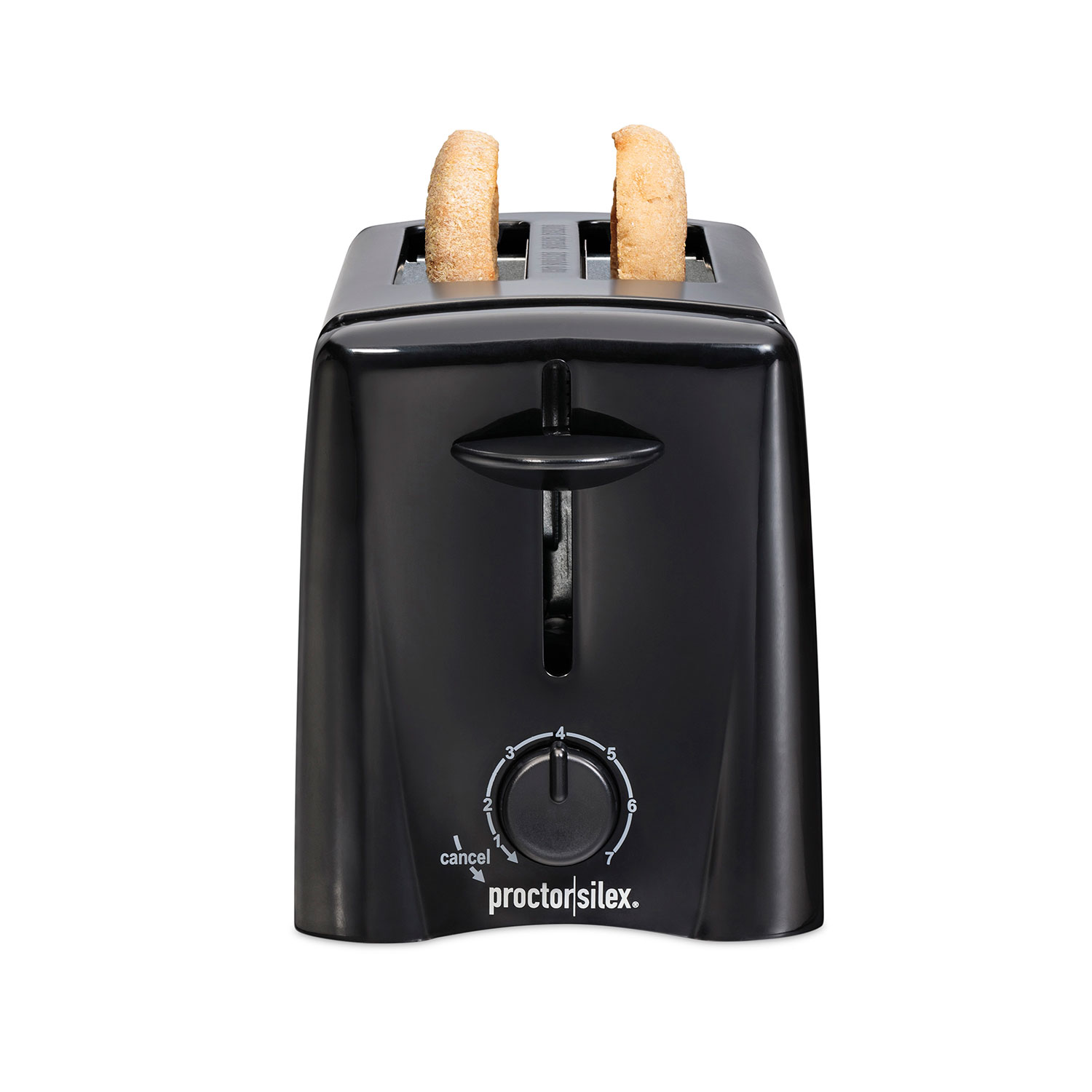
“Wide” should not be confused with a dedicated Bagel mode. The page mentions bagels as an example of food for these openings, but lists a manual shade selector and Cancel rather than a separate Bagel program or heating pattern. The linked booklet also does not document a Bagel control or a dedicated Frozen/Defrost setting, and it warns against some frozen prepared and nonbread foods.
A narrow body measurement needs working room around it
For countertop planning, the manufacturer’s 5.3-inch outside width and 10.1-inch outside depth are usable numeric reference points. At a 5.3-inch maximum width, the body fits that arithmetic screen; at a stricter 5.2-inch limit it does not. A matching body measurement still says nothing about the room needed to load slices, route the cord, keep the toaster in a safe location or reach the crumb tray. The page also gives a 6.3-inch height, but it supplies no overhead-clearance requirement. Treat these figures as the appliance’s stated outside body, not installation clearances.
The compact body and extra-wide openings are different traits: one describes the outside shell, the other slot shape. Because the page provides no numeric aperture, the slot wording is a fit lead rather than a guarantee for thick or irregular food.
Manual controls, shade choices and retrieval
The page specifies seven shades, and its image labels dial positions 1–7. This is one manual control group, not separate pair settings or a sensor that reads toast color. Toast Boost is listed for retrieving small breads; the manual does not document mid-cycle inspection, extra-time, Reheat or motorized lowering. The exact page describes Cancel as stopping a cycle.
The Auto shutoff claim is specifically about the cycle ending if toast gets jammed. It is not a general shade sensor or a guarantee against overheating. The linked manual warns against unattended and enclosed operation; follow that instruction.
Electrical and warranty evidence needs a label check
Booklet 840221507 lists base model 22612/type T93 at 750 W, 120 V and 60 Hz; a footnote says listed codes may carry suffix letters. That supports a family rating for 22612PS, but check the exact unit’s label. The exact page advertises a three-year limited warranty, while the linked booklet states one year in the U.S. The sources do not reconcile the difference or prove present coverage on an older or third-party unit.
The page calls the tray drop-down; the manual diagram calls it swing-open. Check the exact unit and leave space to access it. The booklet says to unplug and cool before cleaning and warns against oversized food, utensils and enclosed use.
Comparison and buying cautions
The 22612PS is not the base black 22612 simply because the codes share a stem. Both are earlier two-slice models, but only the 22612PS sources specify extra-wide slots, seven shades, Cancel and outside dimensions. The white 22611 is another exact model despite a shared T93-family entry. Check the full unit code against the correct page and manual.
The maker says 22612PS is No Longer Available, not that a third party has a unit in stock. Check condition, return terms, included pieces and actual tray access. The saved 2008 recall notice is bounded, series-code dependent and not unit-level clearance.
Bottom line
The 22612PS is an earlier compact, two-slice reference with a seven-position dial and manufacturer-described extra-wide openings. Its page also supplies body measurements, but not opening size; the discontinued status, no-long-slot distinction and unresolved tray/warranty wording all matter. Body-screen fit is not bread fit or safe clearance.
Source: exact U.S. Proctor Silex 22612PS page · Directly linked 840221507 Use & Care booklet · Manufacturer’s bounded 2008 recall information.
Key specifications
Key details at a glance
| Capacity | 2 slices per cycle |
|---|---|
| Body width | 5.3 in |
| Body depth | 10.1 in |
| Body height | 6.3 in |
| Listed power | 750 W |
| Supply voltage | 120 V |
| Line frequency | 60 Hz |
| Shade control | The exact page says seven toast shades and the exact product image displays selector positions 1–7. These are selector settings, not calibrated shade or consistency data. |
| Listed warranty | The exact 22612PS page advertises a 3-year limited warranty, while the directly linked 840221507 booklet states a one-year U.S. term; the exact applicable terms are unresolved. |
Use the exact model’s instructions for operating limits, supplied equipment and version differences.
Sources for this review
Sources for this assessment

Compare the routine, not just the control panel.
Use the finder for combinations of capacity, features and counter limits, then check each exact model's review and instructions.