
Your needs, this model
Does it fit your priorities?
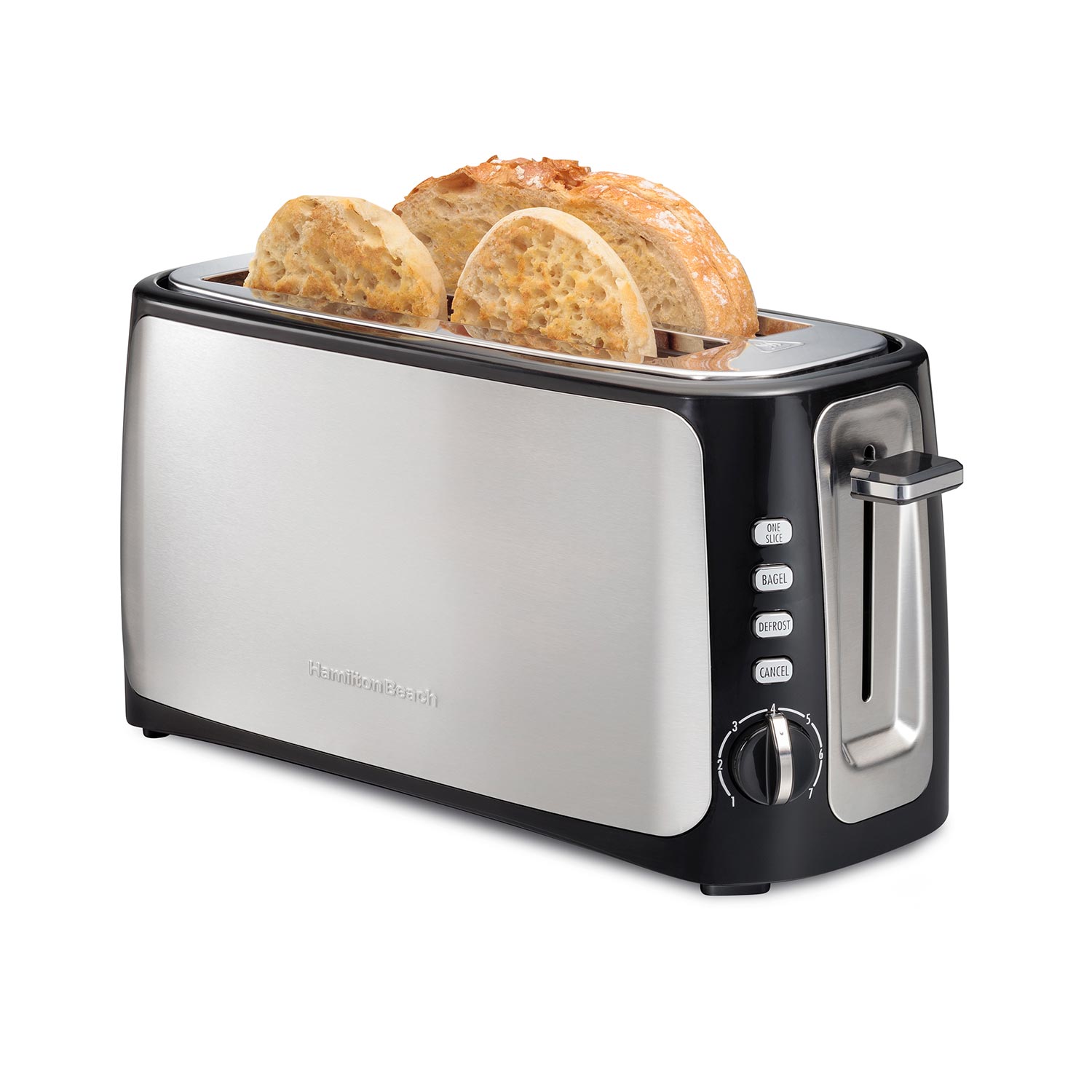
Does the 24820 provide long openings while marketing four-slice capacity?
Yes. The exact page says each of its two extra-long openings fits two slices or one long slice, and the manual diagram shows two openings with one control group. Four-slice capacity does not mean four conventional short slots, and maximum bread length remains unpublished.
Explore this need in the finder →Does 24820 have Bagel and Defrost modes as well as One Slice?
The exact page and linked 840353900 guide identify Bagel, Defrost and One Slice. The guide describes One Slice as a Sure-Toast heater sequence; it does not document automatic frozen-food detection, a post-cycle reheat, or mid-cycle Lift & Look.
Explore this need in the finder →What is the body footprint of the exact 24820?
Hamilton Beach publishes 6.6 inches wide by 15.7 inches deep (7.8 inches high). These are body dimensions only; allow room for safe counter placement, loading, the lifted carriage, cord routing and rear crumb-tray access.
Explore this need in the finder →Hamilton Beach’s 24820 is an earlier four-slice long-slot toaster, not a four-opening machine. The exact U.S. page labels it “NO LONGER AVAILABLE,” so this is a documentary assessment of a model design rather than a current-stock claim or a report of hands-on use. Its clearest distinction is the combination of two extra-long openings with a dedicated One Slice/Sure-Toast control, alongside Bagel and Defrost.
Four-slice capacity in two long openings
The manufacturer says each extra-long, extra-wide opening holds two slices or one long slice. The linked Use & Care guide’s diagram confirms two long openings and a single lifter/control group. That arrangement can handle the maker’s four-slice scenario without putting bread into four separate slots, and it may be easier to compare against a long slice than a conventional four-slot toaster. But “extra-long” is not a numeric measurement: the exact U.S. page and guide do not establish the usable opening length, width, maximum food thickness, or longest slice that fits. Check the actual opening and the size of the bread you plan to use rather than treating the name as a fit guarantee.
The outside body measures 7.8 inches high, 6.6 inches wide, and 15.7 inches deep. That narrow width can be attractive where the counter has a limited side-to-side span, but the depth is substantial. These figures do not include wall clearance, space above the toaster, room to lift the carriage, cord routing, or access to the rear crumb tray. The body footprint and the bread-fit question are separate.
One Slice is a heater sequence, not a shade sensor
The exact 840353900 guide describes One Slice as a Sure-Toast operation: when the cycle begins, the middle heating element is on, then switches off during the cycle to avoid over-browning one side. The manual also says the control applies when toasting one slice or two slices in the same opening. That is a specific electrical sequence, not evidence that the appliance measures toast color or guarantees matching results across bread types. It has one shade selector and one main control group, not separate browning settings for each long opening.
The page and guide also document Bagel and Defrost. The guide describes Bagel as heating one side of a cut bagel, English muffin, or bun; it instructs users to orient the cut face according to the symbol near the slots. Defrost is a separate, user-pressed control that adds time for toaster-suitable frozen food. The manual says to press it after the cycle has started. These are distinct modes, not automatic frozen-food recognition. The page and manual do not show a Reheat, Keep Warm, A Bit More, or mid-cycle Lift & Look control.
The shade dial is described on a 1–7 scale in the linked guide. That is a selector range, not a color-calibration system or measured performance result. The booklet identifies the exact 24820 as Type T131, rated 120 V, 60 Hz, and 1,450 W. This evidence is specific to this model and should not be transferred to a similarly numbered Hamilton Beach toaster.
How it differs from the 24810
The nearby 24810 is also marketed as a four-slice long-slot toaster with two openings and one control group, but its page and linked guide document a Keep Warm period of up to three minutes after the cycle. The 24820’s standout control is instead One Slice/Sure-Toast, and its page lists Bagel, Defrost, and Cancel. Both are marked no longer available, but their model numbers, linked guides, and control sets differ; do not treat a shared long-slot shape as proof they are the same version. The single-opening 22999 is another distinct earlier layout, with one 10-inch slot for two regular slices or one long slice rather than two two-slice openings.
Counter setup and old-unit checks
The page lists a slide-out crumb tray, cord wrap, Toast Boost, and automatic shutoff. The manual says to unplug the toaster and let it cool before clearing lodged food; it cautions against inserting utensils while the toaster is connected. For any old-stock or secondhand offer, verify the label says 24820, inspect the two-slot/control arrangement and cord, confirm the tray and manual are present, and check seller return terms and the actual unit’s condition. The manufacturer’s limited-warranty language is conditional; it does not establish coverage for an old or resale unit. Check current safety notices against the specific appliance rather than assuming a model page settles its history.
The 24820 is most interesting when its two-long-opening, four-slice capacity and One Slice/Sure-Toast sequence fit a known routine. Its 15.7-inch body depth, unavailable status, and unpublished usable bread dimensions are meaningful drawbacks. The source record supports the design and listed features, not hands-on browning, speed, durability, or bread-size testing.
Key specifications
Key details at a glance
| Capacity | 4 slices per cycle |
|---|---|
| Body width | 6.6 in |
| Body depth | 15.7 in |
| Body height | 7.8 in |
| Listed power | 1450 W |
| Supply voltage | 120 V |
| Line frequency | 60 Hz |
| Shade control | The exact linked guide gives a 1–7 shade selector; this is a control range, not a measured browning result. |
| Listed warranty | The linked guide contains conditional limited warranty terms; coverage of any particular old or resale unit is unknown. |
Use the exact model’s instructions for operating limits, supplied equipment and version differences.
Sources for this review
Sources for this assessment

Compare the routine, not just the control panel.
Use the finder for combinations of capacity, features and counter limits, then check each exact model's review and instructions.