
Your needs, this model
Does it fit your priorities?
Does the 22910 toast two slices in one cycle?
Yes. The exact U.S. page calls it a 2-slice toaster and shows two separate openings; the linked guide's model table identifies 22910 as a T110 unit. That establishes capacity, not a particular slice-size fit.
Explore this need in the finder →Does 'extra-wide' mean that the 22910 has a Bagel program?
No dedicated Bagel button appears in the exact page's feature list or the page-linked guide's control list. The maker uses the wide-slot wording for physical food fit; actual bagel dimensions are not published.
Explore this need in the finder →Can the 22910 fit a counter with a 7.5-inch body-width limit?
Its exact page lists 7.48 inches of outside body width, so it is within a 7.5-inch published-body limit. This does not include side clearance, loading access, cord routing or the space needed to open and clean the tray.
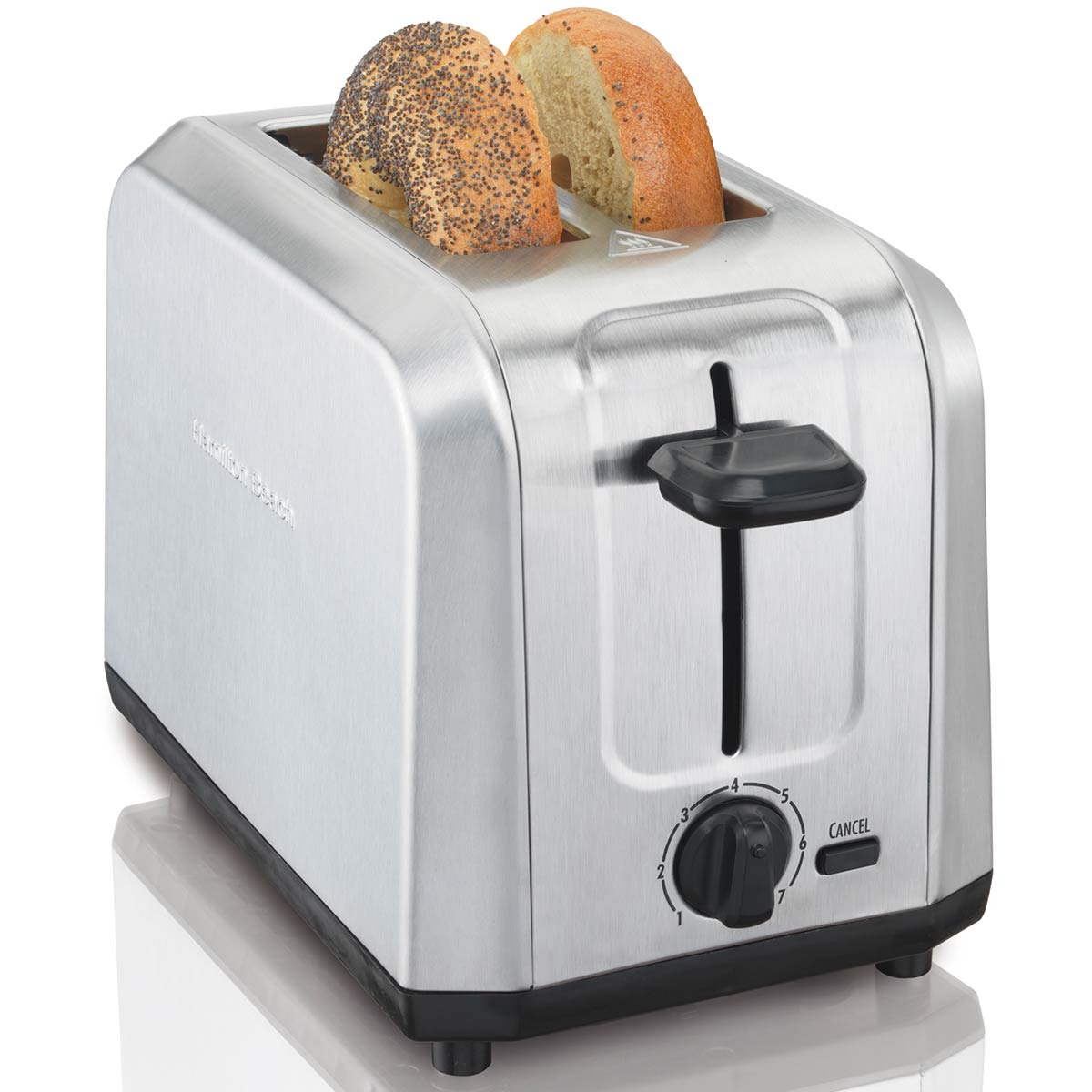
Explore this need in the finder →The 22910 is a plain, conventional two-slice toaster rather than a long-slot model with extra controls. Hamilton Beach’s exact U.S. page identifies two extra-wide openings, a manual high-lift carriage, a shade selector, Cancel with automatic shutoff, a slide-out crumb tray and a cord wrap. Its linked Use & Care guide names model 22910 as Type T110 and lists 120 V, 60 Hz and 820 W. Those details make the basic arrangement fairly legible; they do not establish how evenly it browns a particular loaf.
Two wide openings answer a different need from one long opening
For a two-slice cycle, this model offers one slice in each of two conventional slots. The product page calls them extra-wide and describes bagels, English muffins and thicker artisan bread as examples of foods that may fit. The page does not publish the usable opening width or depth, a maximum food thickness, or a maximum slice length. Bread varies, so “extra-wide” is a screening clue rather than a fit guarantee. Measure the actual food and compare it with the unit’s opening before treating that phrase as decisive.
The distinction matters if you are trying to toast a single long slice: the 22910 is shown with two separate openings, not one continuous long slot. A wider opening does not make a toaster long-slot, and it does not create the specialized center heating behavior of a Bagel setting. The exact page’s feature list and the linked guide’s control inventory do not identify a dedicated Bagel button, despite the page’s separate claim that bagels can fit. The guide also says frozen food may require an additional cycle; that is not a dedicated Frozen or Defrost program.
Simple manual controls, with a high-lift lever
The page and guide describe a manual bread lifter, shade selector and Cancel button. Toast Boost raises the carriage for retrieval; that is useful as a design consideration when small slices are part of the routine, but it is not evidence that a slice will emerge at a particular height in actual use. The exact image shows the shade dial marked from 1 to 7, while the page calls it a shade selector. Treat those markings as settings, not measured color targets or a promise of identical results across breads.
The guide’s basic sequence is to plug the toaster in, place suitable food in the slots, select a shade, lower the lifter and let the cycle finish. It says the lever will not latch unless the toaster is plugged in and the bread pops up automatically when the cycle ends. Cancel ends a cycle early. No source identifies motorized lowering, a color-sensing stop, a dedicated added-time button, mid-cycle lift-and-look, a Sourdough mode or a time-only mode. If any one of those is essential, this model should not be treated as a substitute based only on its shade dial or lever.
Published body size is not counter clearance
Hamilton Beach lists the outside body at 7.48 inches high, 7.48 inches wide and 11.3 inches deep. That makes the width and depth useful first-pass measurements for comparing a counter, but it does not answer how much side or overhead clearance is required. Nor does it include the room needed to insert bread, reach the outlet, route the cord, or slide out the crumb tray. The page-linked instructions warn against operating the toaster inside an enclosed cabinet or storage space and advise unplugging before cleaning. Check those directions and the location of the power cord before choosing a permanent spot.
For routine care, the guide says to unplug the toaster, let it cool, place it on its side, open the crumb tray and wipe it clean. It recommends weekly crumb-tray cleaning when the toaster is used every day. That procedure needs usable access, not just a body footprint that fits between two objects. The guide also warns against operating unattended and removing jammed food while the toaster is plugged in; a utensil is not a safe way to dislodge food.
Keep the exact model and offer separate
The page identifies plain 22910 and the linked manual lists it under T110. The separate 22910G card is a distinct observed suffix, and the exact page we assessed does not prove the finish, package, label or instructions for that version. Likewise, the 22912 is another T110 family model with its own exact page and dimensions; do not transfer the 22912 body size or any suffix identity to this toaster. The 24910 is the separate four-slice T111 model rated at 1500 W in the shared manual, not a higher-capacity configuration of the 22910.
The manufacturer still has a 22910 model page, but a catalogue listing or temporary out-of-stock label does not establish what a particular seller has today. Before ordering or considering a used unit, check the exact model label, surface condition, manual, included parts, seller, return policy and warranty terms. This assessment is based on the published sources and image; it is not a hands-on test, ownership report or claim about current price, stock or toast quality.
Key specifications
Key details at a glance
| Capacity | 2 slices per cycle |
|---|---|
| Body width | 7.48 in |
| Body depth | 11.3 in |
| Body height | 7.48 in |
| Listed power | 820 W |
| Supply voltage | 120 V |
| Line frequency | 60 Hz |
| Shade control | The exact page-linked product image visibly labels the shade dial 1–7; that control scale is not a calibrated color measure or a performance test. |
| Listed warranty | One-year limited U.S. warranty is stated in the page-linked Use & Care guide, subject to its terms. |
Use the exact model’s instructions for operating limits, supplied equipment and version differences.
Sources for this review
Sources for this assessment

Compare the routine, not just the control panel.
Use the finder for combinations of capacity, features and counter limits, then check each exact model's review and instructions.