
Your needs, this model
Does it fit your priorities?
Does the documented 22680 configuration support a two-slice routine?
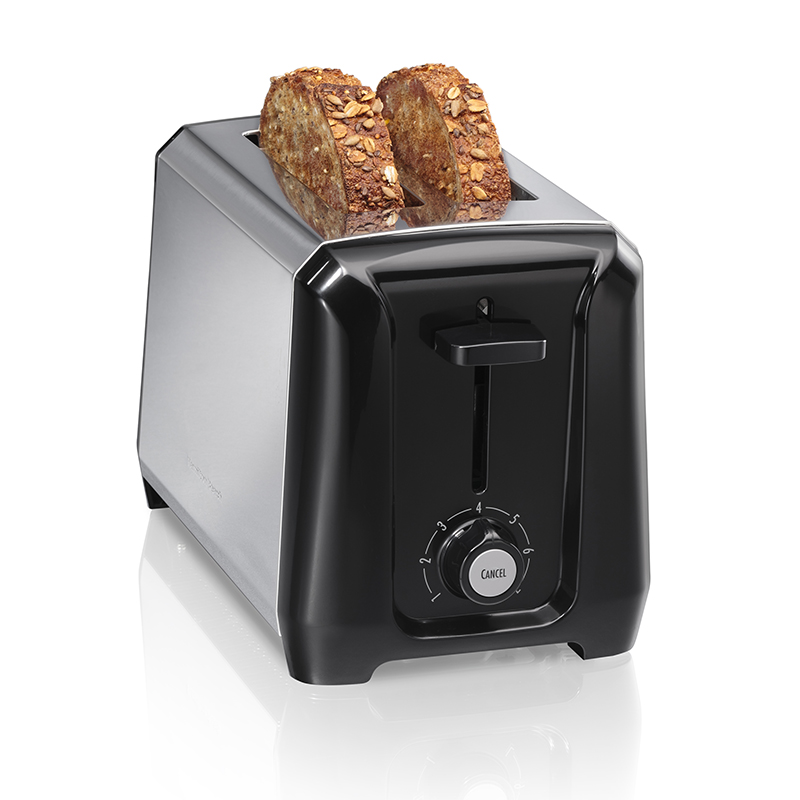
Yes, for a basic two-piece cycle: the exact page-linked image shows two separate openings and the directly linked guide describes one lifter and one manual shade selector. That is a layout finding, not a maximum bread-size or browning-performance claim.
Explore this need in the finder →Should I choose the 22680 if a dedicated Bagel setting is essential?
No. Its directly linked guide lists the slots, lifter, manual shade dial, Cancel and drop-down tray, but does not document a Bagel program. The phrase extra-wide is not a substitute for a dedicated control; the exact unit and manual should be checked before considering any used offer.
Explore this need in the finder →Can the documented 22680 be screened against a strict body-width limit?
Not from the available numeric evidence: neither its exact U.S. page nor the linked manual states outside body width, so the finder does not count it as meeting a width cap. Measure the exact appliance and its working space rather than borrowing another model's dimensions.
Explore this need in the finder →Hamilton Beach · U.S. model 22680 · two-opening toaster
Hamilton Beach's U.S. page identifies the 22680 as a “Stainless Steel Toaster with Extra-Wide Slots” and now labels it NO LONGER AVAILABLE. That status does not prove every seller lacks old stock or used units. This is a paper-based assessment of the exact page, its linked Use & Care guide and page-linked image—not a hands-on test or an ownership report.
A two-opening layout, with a qualitative slot claim
The exact hero image shows two separate top openings, a single bread lifter and one front control group. The manufacturer calls the slots extra-wide, but neither the product page nor the linked booklet supplies a clear opening width, depth, maximum slice length or maximum food thickness. A styled slice sitting in a product image is not a fit gauge. If a loaf is unusually broad or thick, compare its actual dimensions with the specific appliance rather than treating “extra-wide” as a numeric promise.
The 22680 is a conventional two-opening layout, not the long-slot design used for one extended slice. Its visible arrangement is appropriate to a two-piece cycle, but the documents do not tell us which bread sizes fit or how evenly any individual unit browns. If you need more than two slices in one cycle or one longer slice, choose a model whose exact manual establishes the layout you need.
Simple controls—and important features not documented
The directly linked 840307401 guide names the food slots, bread lifter, shade selector, Cancel button and drop-down crumb tray. That is a modest control set: select a shade manually, lower the lifter to start, and use Cancel to end the cycle early. The image shows marks around the dial, but the booklet publishes neither the setting count nor a calibrated shade result.
The manual's feature list does not document a dedicated Bagel or Frozen/Defrost program, Reheat, extra-time button or mid-cycle inspection control. “Extra-wide” describes a maker-named slot characteristic, not a bagel program, and does not establish a fit guarantee for any bagel. For comparison, the separate Hamilton Beach 22633 assessment discusses a model whose exact page and guide do name Bagel and Defrost; that functional distinction should not be transferred backward to the 22680. A need for either dedicated mode should lead you to a configuration with that control documented for its own edition.
Care and food limits come from the manual
The 840307401 guide says that bread should rise automatically at the end of a normal cycle. That is not a claim that the model detects a jam or has a separate safety shutoff, and the same booklet warns users not to leave it unattended. It also advises against using the toaster with fried foods, rice cakes, frozen prepared foods or other nonbread items, and says toaster pastries should be prepared in a toaster oven. Follow the actual appliance instructions rather than reading a generic toaster capability into the slot shape.
For cleaning, the guide says to unplug the toaster and let it cool before working on it. It describes opening the drop-down crumb tray and wiping it; for daily use, it recommends weekly tray cleaning. On a used unit, inspect the tray, cavity, cord, plug and lifter without probing a plugged-in appliance.
Electrical identification: check the label, not a sibling row
The exact-page-linked guide's model table lists 22680 as Type T121, 120 V, 60 Hz and 750 W. The same booklet includes other toasters, including a separate four-slice 24671 with a different Type T122 row and a 1300 W rating. That nearby entry is not the 22680. An older listing should show the bottom rating label clearly; verify that its model and electrical details correspond to 22680 rather than relying on a seller title or a family's shared manual.
The maker calls the outside a stainless-steel toaster, while the image shows a silver-colored side and a dark front panel. Neither source states the steel grade or how much of the exterior uses it. Likewise, the page and guide provide no outside height, width or depth. A counter-fit decision therefore needs a physical measurement of the exact appliance plus a separate check of safe working clearance, cord reach, access to load bread and room to open the bottom tray. This assessment cannot certify that the 22680 fits a particular counter.
What an older offer would need to prove
Because the manufacturer page says NO LONGER AVAILABLE, treat a 22680 listing as an exact-unit identification exercise, not a routine new-product recommendation. Ask for a clear photo of the rating label and model suffix, the appliance itself from several angles, and the supplied manual or a traceable match to guide 840307401. Confirm the seller's stated condition, missing parts, return terms and whether any warranty claim has original-purchase proof; the booklet's printed one-year U.S. limited-warranty language is subject to its terms and does not promise coverage for a particular used or old-stock unit.
A bounded review of the Hamilton Beach recall index and named 2008/2011 CPSC toaster notices did not identify model 22680 in the displayed model lists. That is not an individual series-code or serial-number determination, a comprehensive recall search, or a clearance for an appliance in an unknown condition. Check the actual unit against current official notices. The sensible fit is narrow: someone comparing this exact older two-opening model, content with manual shade selection and no documented special modes, and able to inspect and measure the actual unit. If dimensions, Bagel/Defrost controls, current support or guaranteed availability are essential, the evidence here is not enough to recommend it for that job.
Key specifications
Key details at a glance
| Capacity | 2 slices per cycle |
|---|---|
| Listed power | 750 W |
| Supply voltage | 120 V |
| Line frequency | 60 Hz |
| Shade control | The exact linked guide identifies a manual shade selector but publishes no count of selectable shade steps. The image's dial markings are not used to infer a setting count. |
| Listed warranty | The linked booklet prints a one-year limited-warranty term for qualifying U.S. purchases under its written conditions. |
Use the exact model’s instructions for operating limits, supplied equipment and version differences.
Sources for this review
Sources for this assessment
- Hamilton Beach U.S. toaster archive card for model 22680
- Hamilton Beach exact U.S. product page for 22680
- Exact-page-linked Hamilton Beach Use & Care guide 840307401
- Hamilton Beach exact page-linked 22680 hero image
- Hamilton Beach Recall Information index
- Hamilton Beach 2008 toaster recall notice
- U.S. CPSC 2008 Hamilton Beach / Proctor-Silex toaster recall notice
- U.S. CPSC 2011 Hamilton Beach toaster recall notice for model 22600

Compare the routine, not just the control panel.
Use the finder for combinations of capacity, features and counter limits, then check each exact model's review and instructions.