
Your needs, this model
Does it fit your priorities?
Can the CPT-180P1 toast a four-slice batch while using different settings on each pair?
Cuisinart describes a four-slice model with two control panels. The linked CPT-180 Series booklet says the left controls and carriage lever operate the left slots and the right set operates the right slots, so separate left/right pair settings are documented. That is not four independent shade controls, and it does not promise identical simultaneous results.
Explore this need in the finder →What does the frozen-bagel sequence look like on this model family?
The linked booklet says to halve bagels, choose a shade, lower the carriage, then select Bagel; for a frozen bagel it gives Bagel followed by Defrost after the lever is lowered. Defrost is a user-selected cycle. The manual also says very thick pieces may need a second cycle and must fit freely between the guides, so this sequence is not a fit or browning guarantee.
Explore this need in the finder →Will a long or unusually thick loaf fit the CPT-180P1?
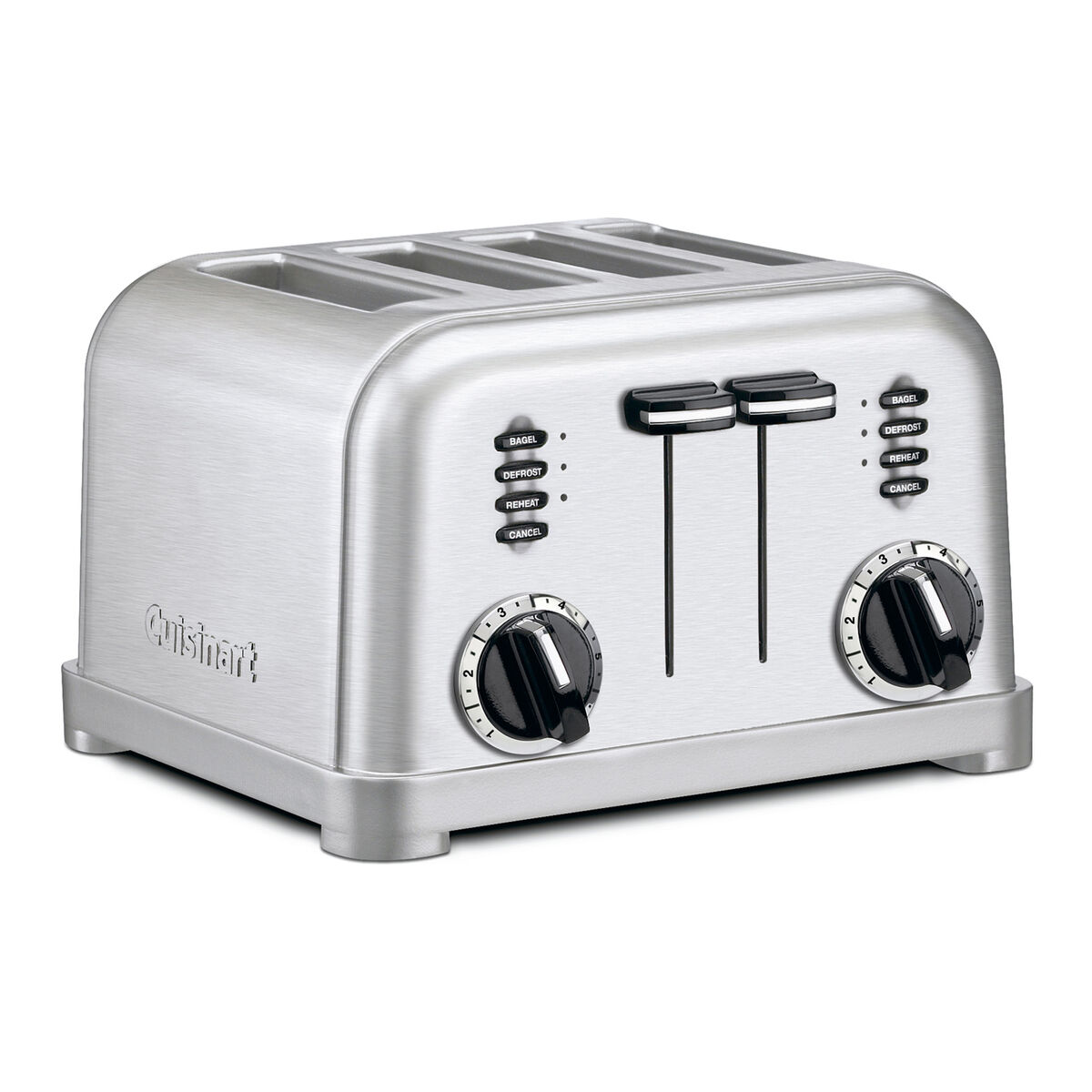
The page and manual list 1.5-inch slot width but no slot length, depth or maximum food dimensions. The exact image shows four separate openings rather than a long-slot layout. Cuisinart cautions against forcing food into the slots and notes that very thick bread may need two cycles; compare the actual bread with the exact opening.
Explore this need in the finder →What counter dimensions and placement checks are documented?
Cuisinart lists 11.15 inches wide, 10.65 inches long and 7.5 inches high. For the photographed front orientation, the review represents length as body depth; verify the orientation on the exact model. Those are outside-body measurements only. The manual gives no numeric clearance and warns against operation under a wall cabinet or in an appliance garage.
Explore this need in the finder →The Cuisinart CPT-180P1 is a four-slice metal toaster whose more useful distinction is its left/right control arrangement. Cuisinart identifies the U.S. version as Brushed Stainless P1, lists two six-setting shade dials, and links a CPT-180 Series instruction booklet from the exact product page. That booklet assigns the left controls and carriage lever to the left pair of slots and the right controls and lever to the right pair. This review assesses the current page, its linked booklet and image; it does not represent ownership, hands-on use, a toast test or measurements taken for this article.
Four openings, two separately controlled pairs
The page calls the CPT-180P1 a four-slice toaster, and its exact product image shows four separate top openings. This is not a two-opening long-slot design. More importantly for a mixed breakfast batch, the manual maps each pair to its own side controls. You can select a different browning dial position for the left pair than for the right pair, rather than setting four slots individually. Cuisinart describes two six-setting dials, and the booklet says levels 1–2 are light, 3–4 medium and 5–6 dark.
That layout is a practical fit question, not evidence of a particular result. A user might want a lighter setting for one pair and a darker setting for the other, but the sources do not establish how evenly bread of different moisture or thickness will toast together. Use the panel and lever corresponding to the pair you load, and treat the dial as a selectable range rather than a calibrated promise of color.
What the slot information does—and does not—say
Cuisinart and the linked manual describe slot width as 1.5 inches. Neither source supplies an opening depth, opening length, or maximum food dimension. The product photo confirms four separate openings but cannot resolve how a particular loaf, pastry or thick bagel will fit. The manual says not to force food between the guides and notes that especially thick pieces may need two cycles. Before choosing this model for a homemade slice or an oversized pastry, compare that food with the actual slot instead of treating four-slice capacity or metal styling as a size specification.
The name and four-opening image also matter when comparing products with “XL” or “long-slot” language. Those terms are not interchangeable. A long opening may accept a longer slice while still handling fewer slices in a batch; the CPT-180P1 instead shows four shorter openings. The manual gives advice for halved bagels, but that does not certify every bagel diameter or thickness.
Bagel, Defrost and Reheat are different jobs
The directly linked booklet gives useful control distinctions. Bagel adds time to the cycle for thicker bread. Defrost first warms frozen bread and then toasts it. For a frozen bagel, the booklet says to set the shade, lower the carriage, and then press Bagel followed by Defrost; it also says to cut bagels in half. Reheat is described as warming bread without browning or toasting, while Cancel interrupts a cycle. These are documented operating instructions, not a claim that the buttons produce a tested texture or reliable result for every food.
The machine has an extra-lift lever to raise small items for removal. That is not the same documented feature as a Lift & Look function that raises food during a cycle and returns it to continue. The CPT-180P1's exact page and linked booklet do not list a dedicated +30 Seconds control, automatic frozen sensing, a color sensor or a separate timer mode. If those specific functions are essential, compare a model whose exact instructions establish them rather than infer them from the word “lever.”
Dimensions and placement checks
Cuisinart lists the body at 10.65 inches long, 11.15 inches wide and 7.5 inches high. For the front-facing orientation shown in the image, this assessment treats the listed length as front-to-back depth and width as side-to-side; verify the dimensions and orientation against the exact unit. These are outside-body figures, not working clearances. The linked booklet warns against operating beneath a wall cabinet or inside an appliance garage, but it does not give a numeric safe spacing. Check outlet reach, space for the levers and loading, and room to pull out the crumb tray as part of the actual counter assessment.
The booklet states that the toaster is designed for 120-volt outlets. The reviewed exact page and booklet do not establish wattage, frequency or a verified weight, so those figures are left open rather than borrowed from another CPT-180 model. The page lists a three-year limited warranty; the booklet describes U.S. household-use eligibility and proof-of-purchase conditions. Confirm current warranty terms for the offer and seller you are considering.
How it compares with related four-opening Cuisinart designs
The CPT-180P1 should not be collapsed into the CPT-1800 because both are four-opening stainless designs. The CPT-1800's reviewed sources document seven shade levels, Single, +30 Seconds and QuickView, while the CPT-180P1 booklet specifies six shade levels, pair-specific left/right controls, and Bagel, Defrost and Reheat. The CPT-1800's “XL-slot” description is not a numeric fit measurement either, so inspect the exact layout rather than choosing by similar model number.
The CPT-142P1 offers another four-opening, pair-controlled arrangement, but its plastic compact body and seven shade levels belong to that separate model's own booklet. The CPT-1400 listing names QuickView and +30 Seconds, yet its reviewed U.S. evidence does not establish the pair assignment as clearly as the CPT-180P1 booklet does. These distinctions can matter more than the shared four-slice label.
Who should compare it
The CPT-180P1 merits comparison when four slices per cycle, manual left/right pair settings and dedicated Bagel, Defrost and Reheat buttons match the routine. Its 1.5-inch listed slot width and published body size are useful starting facts, but the slot's other dimensions and maximum food fit remain unknown. It is not a long-slot answer, and its extra-lift lever is not documented as mid-cycle inspection. Check the exact CPT-180P1 identity, included manual, electrical version, counter placement and seller terms before selecting an offer.
Sources: The exact Cuisinart U.S. CPT-180P1 page identifies the finish, controls, listed slot width, body dimensions, warranty summary and linked booklet/image. Its linked CPT-180 Series instruction booklet supports the control assignments and operating sequence described above. The CPSC toaster recall index was only a limited screen; no comprehensive recall or safety conclusion is made.
Key specifications
Key details at a glance
| Capacity | 4 slices per cycle |
|---|---|
| Body width | 11.15 in |
| Body depth | 10.65 in |
| Body height | 7.5 in |
| Supply voltage | 120 V |
Use the exact model’s instructions for operating limits, supplied equipment and version differences.
Sources for this review
Sources for this assessment
- Cuisinart U.S. 4 Slice Metal Classic Toaster exact CPT-180P1 page
- Cuisinart CPT-180 Series Metal Classic 4-Slice Toaster Instruction Booklet linked from CPT-180P1
- Cuisinart official CPT-180P1 main product image linked from exact U.S. page
- Cuisinart U.S. toaster category observation, 12 products shown
- U.S. CPSC toaster recall index and limited exact-model search

Compare the routine, not just the control panel.
Use the finder for combinations of capacity, features and counter limits, then check each exact model's review and instructions.