
Your needs, this model
Does it fit your priorities?
How many slices does the CPT-122 document per cycle?
Cuisinart identifies it as a two-slice model with two separate openings. It is a small-batch conventional-slot layout, not a four-slice toaster or a single long-slot machine.
Explore this need in the finder →How does the CPT-122 handle frozen bread and bagels?
Its booklet says Defrost first warms frozen bread and then toasts it. For a frozen bagel, choose a shade, lower the carriage, then select Defrost and Bagel; Bagel adds cycle time. The booklet says to halve bagels and does not describe a cut-side-only heating mode.
Explore this need in the finder →What counter dimensions are published for the CPT-122?
The maker lists 11 inches wide, 6.5 inches long and 7.2 inches high. The assessment maps the listed length to front-to-back body depth for the illustrated front-facing orientation; verify orientation on the exact unit. These are outside dimensions, not safe overhead clearance.
Explore this need in the finder →Can the CPT-122 use separate shade controls for different slot pairs?
No separate pair controls are documented. Its manual describes one browning dial and one manual carriage for its two conventional slots; compare a two-pair four-slice layout if different batches need different shade settings.
Explore this need in the finder →Should I expect to buy a new CPT-122 from the manufacturer?
No such expectation is supported: Cuisinart labels the exact White CPT-122 page discontinued and out of stock. If comparing an old-stock or secondhand offer, check the exact CPT-122 code, condition, return policy, seller, crumb tray and any warranty terms rather than treating the old page as current inventory.
Explore this need in the finder →This document-based assessment is for the U.S. red Cuisinart CPT-122R, not the White CPT-122 or a guess based only on a replacement-part code. Cuisinart’s exact R page identifies the red toaster, marks it discontinued and out of stock, and links the CPT-122 Series booklet. The review describes those sources; it does not report hands-on use or toast testing.
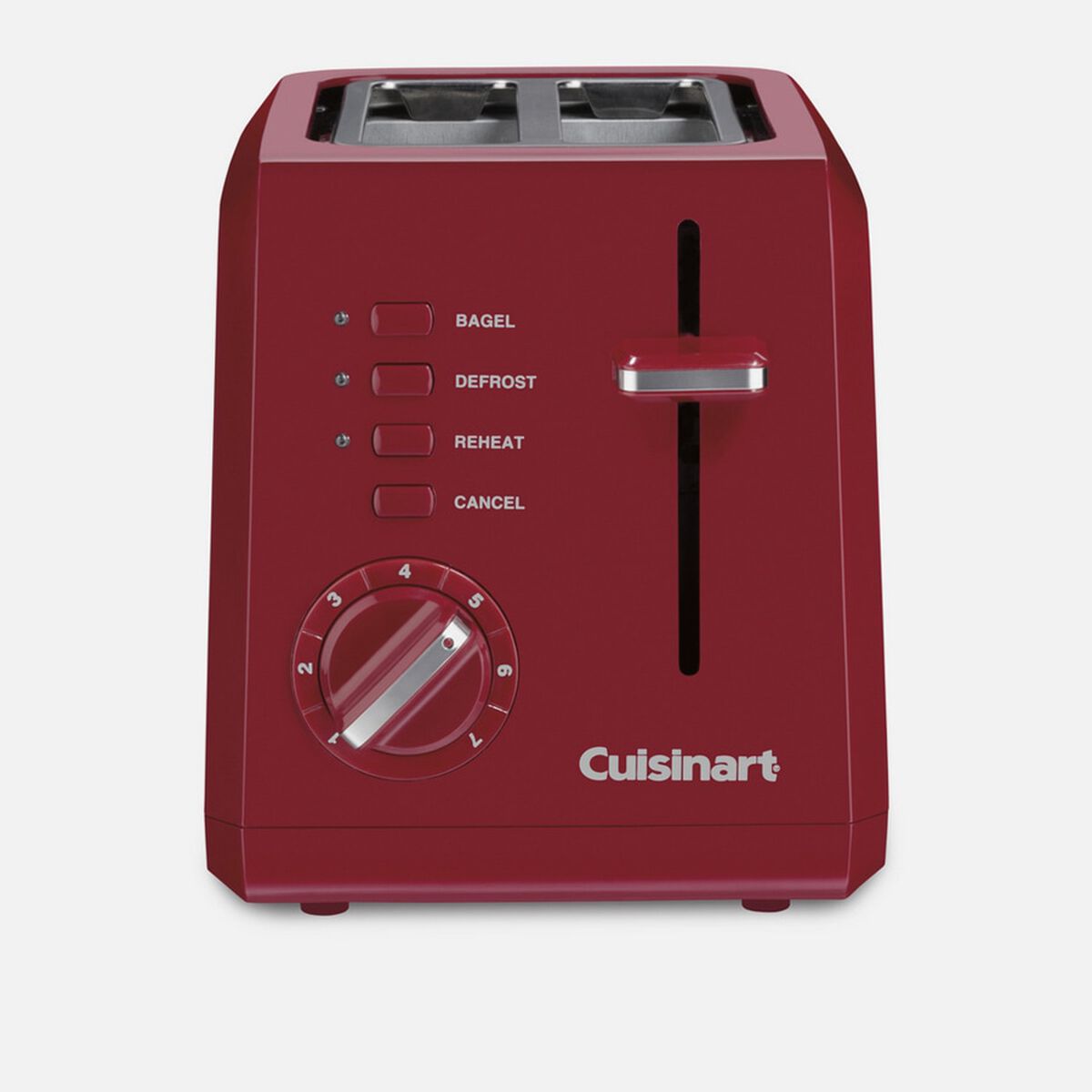
A small two-slice batch with a manual layout
The exact manufacturer page calls the CPT-122R a two-slice compact toaster and lists two 1.5-inch-wide slots. Its directly linked series booklet describes a manual carriage, one shade dial with seven numbered positions, a high-lift mechanism and automatic raising at the end of a cycle. The documented shade guide groups 1–2 as light, 3–5 as medium and 6–7 as dark. That is a usable control map, not a prediction of a particular color: the booklet notes that bread moisture, thickness and surface affect how a setting behaves.
These are two conventional openings, not a single long slot and not two independently controlled zones. For one slice, the booklet recommends a lighter setting because the toaster heats its chamber for a two-slice cycle. A cut bagel is the supported way to use the named Bagel control; the manual describes added cycle time, not a cut-side-only heat mode. The published 1.5-inch dimension is width only. Neither the exact R page nor the linked booklet states maximum slice length, slot depth or a maximum food thickness, so check the actual bread rather than treating “wide” as a fit guarantee.
Separate buttons, separate jobs
Bagel, Defrost and Reheat are distinct controls. The booklet says Bagel adds time, while Defrost first warms frozen bread and then toasts it. For a frozen bagel it gives a combined Defrost-and-Bagel sequence after shade selection and lowering the carriage; it also says to cut bagels in half before loading. Reheat is described as warming bread without browning or toasting. Cancel interrupts a cycle. These details help distinguish a manual control routine from a model that merely has an automatic frozen-food sensor, but they do not establish that every frozen food or pastry belongs in a toaster.
The same booklet warns that very thick slices may take longer or need another cycle, and that food should never be forced between the guides. It also cautions that pastry filling can get hot before the outside looks browned. These are practical restrictions worth retaining when comparing the R with newer sensor-driven models. No mid-cycle inspection, adjustable timer or dedicated single-slice button is documented for the CPT-122R.
Counter fit is an open question for the red edition
Cuisinart’s exact red page and the shared manual do not publish the R’s outside width, depth or height. The separately reviewed White CPT-122 page lists body dimensions, but those figures are not assigned to the R without an exact R measurement. A shared product-family booklet and similar appearance support the control-family comparison; they do not establish a numeric body-size match for this exact model code. If a counter limit matters, measure the offered red unit itself and keep operating clearance separate from the body footprint.
The manual says not to operate the toaster below wall cabinets or inside an appliance garage, and to unplug it before cleaning. Let it cool, slide out the crumb tray, clear crumbs, wipe it with a damp cloth and replace the tray before operation. It also says not to put sharp tools in the slots and not to try to dislodge food while the unit remains plugged in. Those instructions matter more than a compact-looking product image when evaluating a crowded counter.
Keep the model code and condition attached
Cuisinart marks the exact CPT-122R page discontinued and out of stock. That is the manufacturer page’s status, not proof that no secondhand or old-stock unit exists. The page lists a limited three-year warranty, but a historical statement does not establish coverage for an old, used or independently resold toaster. Check the exact R suffix, condition, included tray, seller return policy and any warranty terms before comparing an offer. The manufacturer’s CPT-122CT crumb-tray page also lists CPT-122R by code; verify the actual replacement part and package rather than assuming a tray is present.
The exact White CPT-122 is a close comparison for the same manual two-slot control family. Both exact pages and the linked series instructions document the principal button set, but the White page’s numeric body measurements do not answer the R’s missing counter-size fields. Choose between the identities by finish and exact listing, and treat the red model as a separate assessment when a specific part, measured footprint or seller condition matters. The original official red image is included because its exact R page now resolves the color mismatch observed on the White page; its appearance supports identification only.
Who should keep the CPT-122R in view?
The R is relevant if an earlier red two-slice model with a manual dial, Defrost, Bagel and no-browning Reheat answers the task. It is a poor evidence-based fit if a verified body-width or depth ceiling, maximum bread length, long-slot layout, independent pair settings, automatic frozen sensing or a current manufacturer offer is essential. Those needs require different documented fields, not optimistic inference from this toaster’s family resemblance.
For an exact comparison, confirm the red CPT-122R marking on the appliance and any seller listing, inspect wear and tray completeness, measure the actual body and consult the linked booklet. The record keeps unknown measurements unknown and makes no claim about present resale availability, performance, safety certification or recall status.
Sources checked 2026-11-01: Cuisinart’s exact U.S. CPT-122R product page, the CPT-122 Series instruction booklet linked from that page, and the manufacturer crumb-tray compatibility page.
Key specifications
Key details at a glance
| Capacity | 2 slices per cycle |
|---|---|
| Supply voltage | 120 V |
| Shade control | One manual shade dial with seven positions; the booklet groups 1-2 as light, 3-5 medium and 6-7 dark. Bread moisture and thickness affect time; no even-browning guarantee is implied. |
Use the exact model’s instructions for operating limits, supplied equipment and version differences.
Sources for this review
Sources for this assessment

Compare the routine, not just the control panel.
Use the finder for combinations of capacity, features and counter limits, then check each exact model's review and instructions.