
Your needs, this model
Does it fit your priorities?
How many slices can the Eye Q 850 handle in one cycle?
Breville names it the Eye Q 850 Auto 2 Slice, and the US manual distinguishes it from the four-slice BTA870. Treat two slices as the documented batch, not as evidence about the opening size or how fast it handles a household's whole breakfast.
Explore this need in the finder →Does this model choose the end point by color or by a fixed timer?
Its default Eye Q mode uses an optical sensor to track the bread's surface color and stop at a selected one of seven shades. Breville says the sensor scans ten times per second. Those are documented control features, not independent measurements of evenness or a promise that every bread reaches the same result.
Explore this need in the finder →Can it toast frozen bread without a separate Frozen button?
The instruction book says to use the ordinary sensor-mode steps: the shade sensors detect the color change as frozen bread toasts. There is no dedicated Frozen button, unlike the BTA720XL and BTA820XL. Choose a question about a separate Frozen control if that exact control is essential; this model's automated sensing is a different arrangement.
Explore this need in the finder →Which bread-specific controls are documented?
The manual lists Sourdough mode and a Bagel / Crumpet / English Muffin mode. It directs users to face the side needing more heat outward for the latter mode. That differs from the inward-facing cut surface described in the BTA820XL manual, so don't transfer instructions from a related model.
Explore this need in the finder →Can I use time-based toasting for waffles or pastries?
Yes. The manual says Timer mode disables shade sensing and runs for a set time, and describes it for waffles or pastries that require a specific time or do not change color while toasting. It also says to use the lowest shade setting for toaster pastries; follow the instructions for the exact food and stay with the toaster.
Explore this need in the finder →The Eye Q 850 is a two-slice toaster built around a different question from a numbered browning dial: what shade should the toaster watch for? Its sensor mode tracks visible color and ends the cycle at a selected shade, while a separate Timer mode deliberately turns that sensing off. Those are documented operating features, not proof of uniformly browned bread; this assessment is not a hands-on or laboratory test.
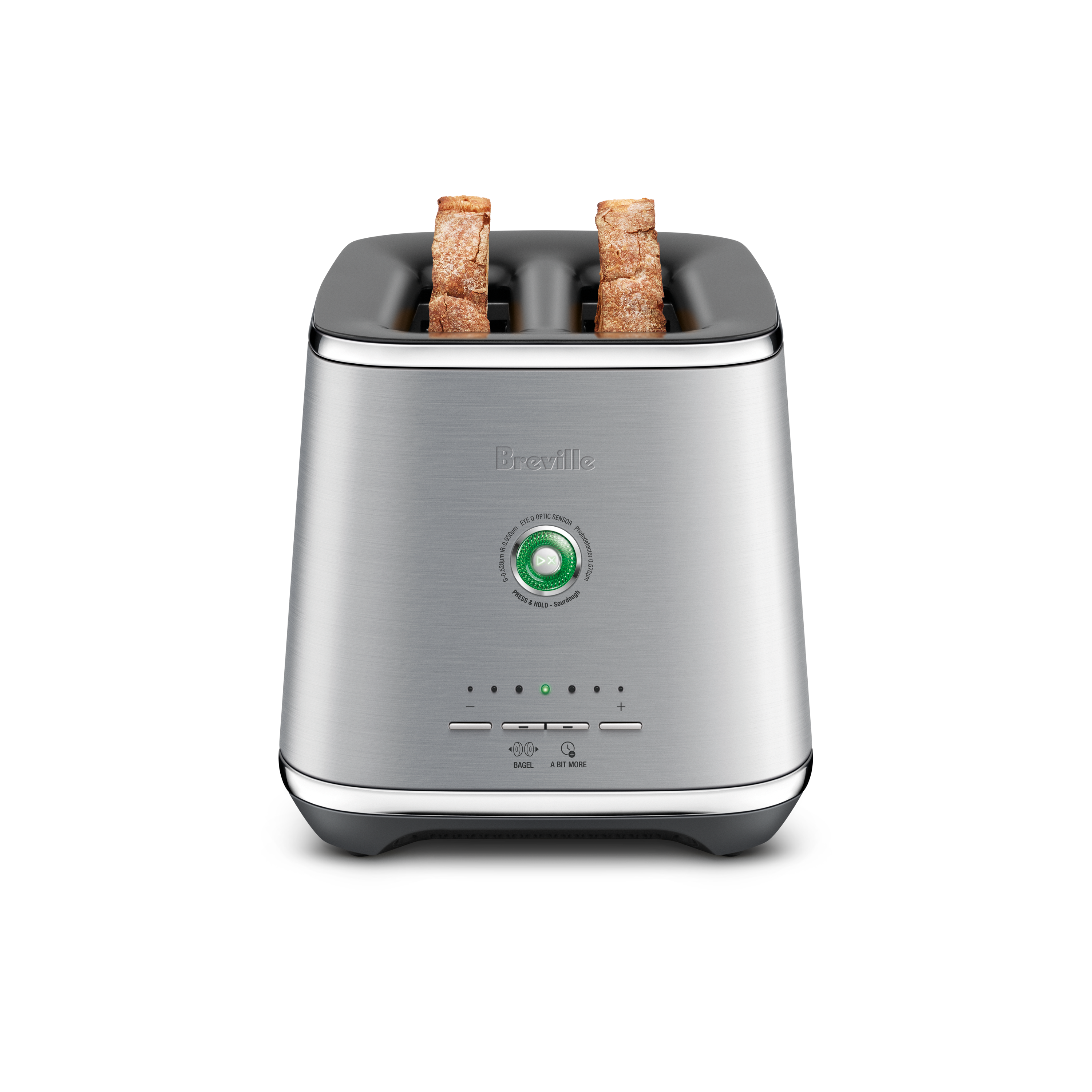
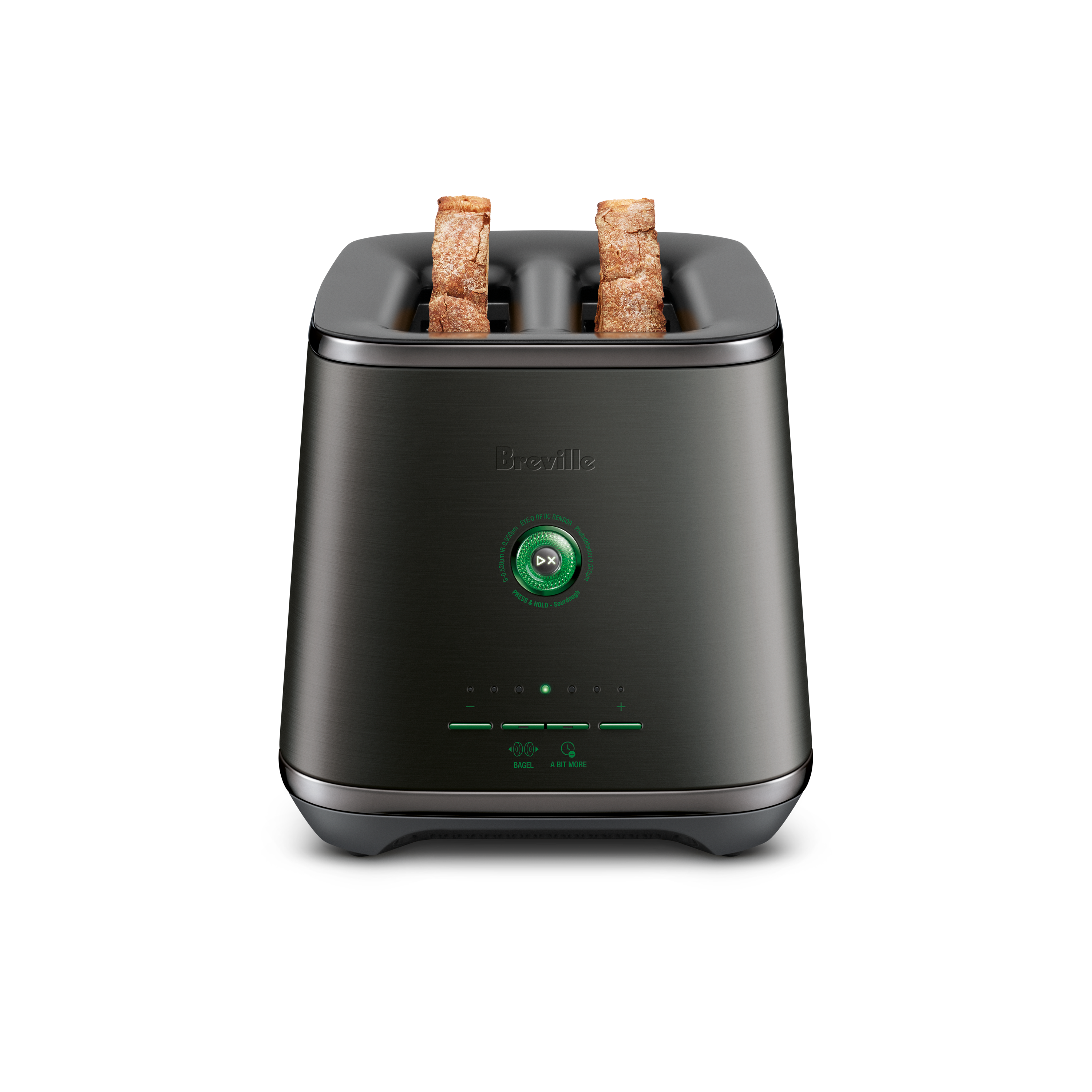
Two finishes, one documented BTA850 setup
Breville’s US page lists BTA850BSS1BNA1 (Brushed Stainless Steel) and BTA850NLE1BNA1 (Noir Launch Edition) under the same BTA850 parent. Its product page and manual show no functional difference between these finishes. Other BTA850 support item numbers are not identified here, so confirm the full suffix before applying this assessment to an offer.
The shared US instructions describe a two-slot, two-slice arrangement. They do not give numeric opening width, depth, or maximum slice length. “Extra wide” language can help identify the intended design, but it is not a measured promise that an unusually broad or tall piece of bread will fit without catching.
Shade sensing is the central distinction
In default Eye Q mode, the toaster lowers bread and monitors its surface color; Breville says the sensor scans ten times per second. The manual describes seven shade positions and says the carriage rises when the target is reached. These are control descriptions, not independent measurements of sensor accuracy, slice-to-slice consistency, or cycle time.
That differs from the Breville BTA720XL and BTA820XL, where the instructions describe a browning slider and named buttons rather than an optical shade stop. The Eye Q also does not have a separate Frozen button. Instead, the manual says to use the ordinary sensor-mode steps for frozen bread because the sensor detects the change in color as it toasts. That is a meaningful distinction for a shopper who wants automatic frozen-bread handling, but not a fit for someone who specifically wants a dedicated button labeled Frozen.
Timer mode disables the shade sensor and runs for a set time. The manual suggests it for waffles or pastries needing a specific time, or foods that do not visibly change color. For toaster pastries, it says to use the lowest shade setting; follow the food and toaster instructions and stay with the appliance.
Special-bread controls have instructions worth noticing
The BTA850 has a Sourdough mode, which Breville describes as using an adjusted cycle intended to reduce the chance of burning a crust—not a guarantee for every loaf or shade. “A Bit More” is separate: the manual says to press it after the cycle when toast needs extra time, rather than choosing a darker target beforehand.
The dedicated Bagel / Crumpet / English Muffin mode applies more heat on one side; the BTA850 instructions direct the surface needing more browning outward, toward the outer elements. That differs from the BTA820XL manual, which directs the bagel cut face inward toward the middle elements. Follow the exact model’s instructions.
The manual marks one sensing slot with a bread icon containing the number 1 and requires a single slice to sit in front of that sensor. If it detects no bread, the carriage rises and returns to ready mode. One-slice users should check the marked slot position; do not assume either opening works identically.
Counter fit and care matter as much as modes
Breville publishes outside dimensions of 7.52 inches wide, 8.15 inches deep, and 12.48 inches high (W × D × H). The manual calls for at least four inches from surrounding sides and eight inches above, and says the toaster is not suitable for a small-appliance enclosure. Check the full space, plug and control access, loading room, and tray access; body dimensions are not a clearance calculation.
The manual rates BTA850 at 1,200 watts on 120 V / 60 Hz, which is information to check against the intended US outlet and kitchen circuit. Breville describes a steel housing, a ceramic-coated top cap, a crumb-guiding cavity, and a fully removable catch-all tray. The manual says to unplug and allow the toaster to cool before cleaning, to keep the tray in place during use, and not to put that tray in a dishwasher. It also warns against using metal utensils to remove jammed food. Regular crumb removal and a counter position that lets the tray slide out are ordinary ownership tasks, not optional extras.
Who should investigate it—and what remains unknown
Compare it when two slices per cycle are enough and color sensing, automatic frozen-bread handling, Timer mode, or sourdough and specialty-bread controls fit your routine. It is not the obvious choice if you need four slices at once, a dedicated Frozen button, a conventional Lift & Look control, or a verified slot-opening measurement.
The US page lists a two-year limited warranty; verify terms and seller for the exact variant. No independent performance, noise, durability, or installation measurements are represented. Slot dimensions remain unknown, and the limited recall screen is not a safety certification.
Key specifications
Key details at a glance
| Capacity | 2 slices per cycle |
|---|---|
| Body width | 7.52 in |
| Body depth | 8.15 in |
| Body height | 12.48 in |
| Listed power | 1200 W |
| Supply voltage | 120 V |
| Line frequency | 60 Hz |
| Listed warranty | 2 Year Limited Product Warranty |
Use the exact model’s instructions for operating limits, supplied equipment and version differences.
Sources for this review
Sources for this assessment
- Breville US product page: the Eye Q 850 Auto 2 Slice (BTA850BSS1BNA1, Brushed Stainless Steel)
- Breville US product page: BTA850NLE1BNA1 (Noir Launch Edition variant)
- Breville Eye Q Auto 2 and 4 Slice US instruction book, issue A26 (BTA850/BTA870)
- Breville US support category: 2 Slice Toaster
- US Consumer Product Safety Commission recalls
- Breville US current BTA850 parent product page, refreshed through exact support-code query
Compare the routine, not just the control panel.
Use the finder for combinations of capacity, features and counter limits, then check each exact model's review and instructions.