
Your needs, this model
Does it fit your priorities?
Can it make four slices in one cycle?
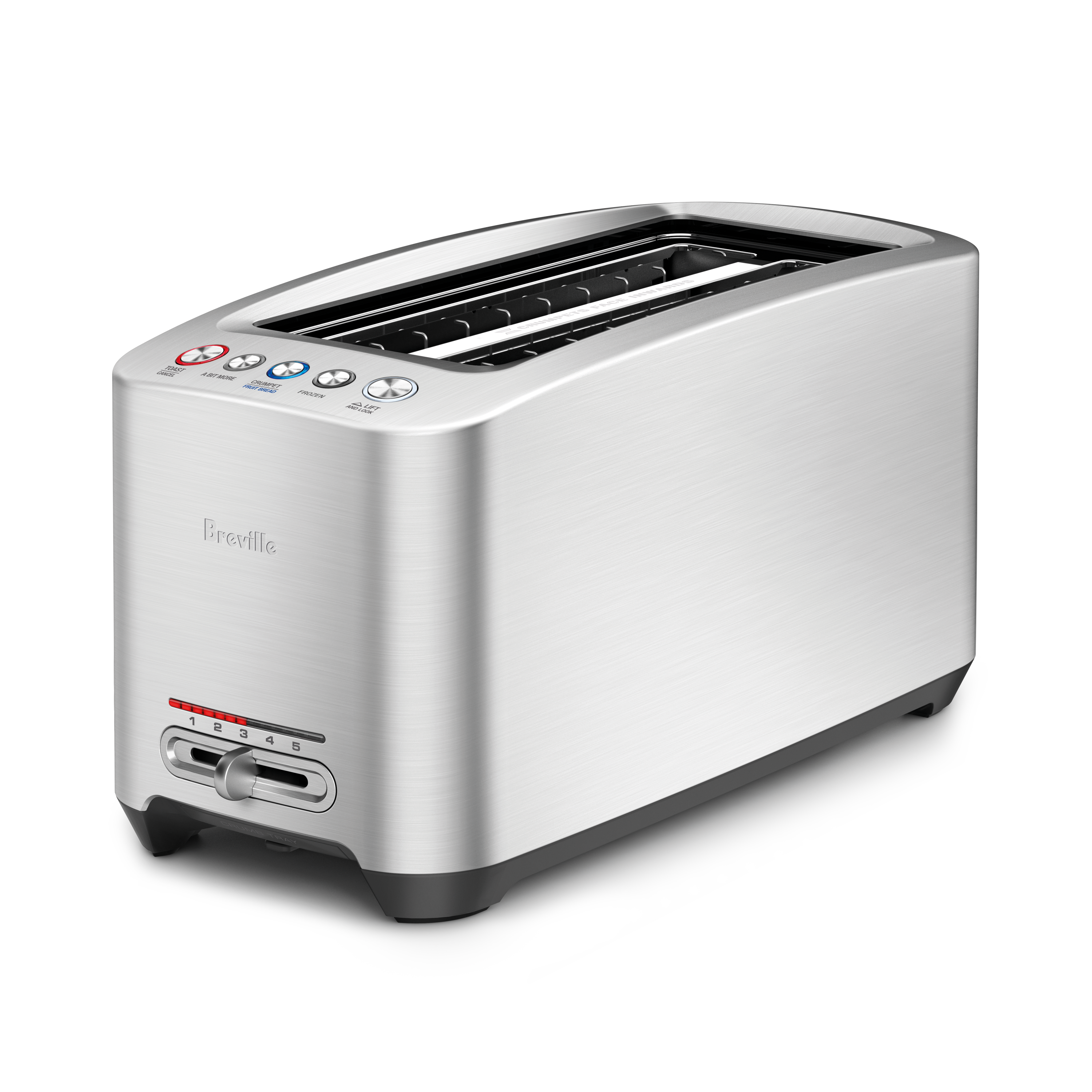
Breville calls the BTA830XL a long-slot four-slice toaster, and the US product page identifies the exact SKU. That is a manufacturer capacity claim, not a measurement of the opening or a guarantee that every unusually long or thick slice will fit.
Explore this need in the finder →Does it have a long-slot layout for longer bread?
Yes. The US product page describes a long-slot design for four-slice capacity. Neither the product page nor the manual supplies a maximum slice length or the opening width, so compare the actual loaf and follow the model's size and jam warnings rather than treating the label as a fit guarantee.
Explore this need in the finder →Can separate slot pairs use different browning settings?
The BTA830XL manual shows one variable browning slider and one function-control set; it does not document independently controlled pairs. Breville's page uses the phrase ‘Dual Toast Control,’ but the manual does not establish two independently set zones, so this assessment does not treat that phrase as pair-level control.
Explore this need in the finder →The BTA830XL is the long-slot branch of Breville’s toaster range: the US product page calls it a four-slice model, but the layout and controls differ from a conventional four-slot toaster. That distinction matters more than the matching capacity number. This is a source-based assessment of the exact US BTA830XL offer, not a hands-on test; no toast results, timing measurements, or ownership experience are claimed.
Long-slot capacity is not the same layout as four separate slots
Breville describes the BTA830XL as a “Long-slot 4-slice” toaster and positions its longer openings for larger artisan-style bread. The product page’s listed outer dimensions are 7.7 inches wide, 14.9 inches deep, and 7.5 inches high. Those figures describe the body, not the length or width of each opening. The company does not publish a maximum slice length or a numeric slot-opening width in the sources reviewed, so the long-slot label cannot certify that a particular loaf, thick bagel, or irregular slice will fit.
The distinction is useful when comparing this model with the Breville BTA840XL. Both are described for four slices per cycle, but the BTA840XL is a four-slot machine with two independently set slot pairs. The BTA830XL manual instead shows one variable browning slider and one function-control set for its long-slot arrangement. It is the more relevant layout to investigate when longer pieces are the concern; the four-slot BTA840XL is the stronger paper fit when separate settings for two pairs matter. Neither layout promises even browning across every bread shape.
One shade control, with several named bread functions
The BTA830XL’s model-specific manual documents a single variable browning slide, a progress indicator, and controls for Toast/Cancel, A Bit More, Bagel, Frozen/Defrost, and Lift & Look. In the manual’s instructions, Bagel changes the heating pattern for a cut bagel placed in the marked direction, while Frozen adds time for frozen bread. A Bit More adds a short extra interval; Lift & Look briefly raises the carriage to check progress without cancelling the cycle. These are useful distinctions in the control scheme, not evidence that the toaster produces a particular shade or texture on demand.
Breville’s US page also uses the phrase “Dual Toast Control,” while the manual presents one browning slider. The page explains the phrase only as offering different levels of brownness; it does not say that each long slot or pair can use a separate setting. This assessment therefore treats the named shade slide as one shared control arrangement, not as independently adjustable zones. The product page’s “5 Settings” wording and the manual’s description of 12 browning settings across a 1–5 scale also do not line up cleanly. I leave the exact shade-step count out of the comparison rather than turning either wording into a match rule.
Plan for the depth as well as the width
At 14.9 inches deep, the published body reaches farther back than the smaller two-slice Breville configurations reviewed here. Measure the counter from the front edge to the wall or backsplash, and include space for the power cord and for pulling out the crumb tray. The manual calls for at least four inches of space at the sides and eight inches above, and advises against enclosed placement. These are manufacturer instructions, not a guarantee that a particular cabinet layout is safe or suitable. The listed 7.7-inch width alone is not a complete counter-fit answer.
Care and jam limits are part of the fit decision
The manual describes a removable front crumb tray. It directs users to unplug the toaster and let it cool completely before cleaning, then empty and replace the tray before use. It warns that crumbs can create a fire hazard if they build up. The same instructions caution against bread that is too thick or long to clear the slots and carriage, and warn not to use metal utensils or try to dislodge food while the unit is plugged in. A longer opening expands the kinds of bread the design aims to accommodate, but it does not remove the need to check fit or follow the manual’s jam procedure.
Who should compare it—and what remains unverified
The BTA830XL is worth comparing when four slices per cycle and a long-slot arrangement answer a real bread-shape need, and when a deep counter position is available. Shoppers who want separate browning settings across two pairs should compare a model whose manual explicitly documents independent pair controls instead. The exact offer should be checked for the BTA830XL suffix, the Brushed Aluminum finish, the supplied manual, warranty terms, seller, and return conditions; a family name or generic product card is not enough to confirm a package.
Opening dimensions, maximum slice length, actual cycle time, shade uniformity, noise, energy use, and long-term reliability were not measured. Breville’s product page describes features and lists technical specifications, while its manual explains intended operation and limits. That evidence can support a fit comparison, but not a claim of tested performance. Before choosing it, compare a sample of the bread you actually buy with the manual’s size warnings and map the full body, clearance, outlet, and tray-access footprint on the counter.
Key specifications
Key details at a glance
| Capacity | 4 slices per cycle |
|---|---|
| Body width | 7.7 in |
| Body depth | 14.9 in |
| Body height | 7.5 in |
| Listed power | 1600 W |
| Supply voltage | 120 V |
| Line frequency | 60 Hz |
| Shade control | Breville's page calls out ‘5 Settings’ and lists ‘Dual Toast Control’; the BTA830XL instruction book describes 12 browning settings across a 1–5 scale and shows one variable browning slider, not separate pair controls. The exact shade-step terminology is not used as a numeric fact or match rule. |
| Published weight | 8.25 lb |
| Listed warranty | 1 year limited warranty |
Use the exact model’s instructions for operating limits, supplied equipment and version differences.
Sources for this review
Sources for this assessment
- Breville US product page: Die-Cast Smart Toaster (BTA830XL)
- Breville US BTA830XL instruction book, current product-page link (E20)
- Breville US Diecast Smart Toaster instruction book, BTA830XL issue C12
- Breville US Diecast Smart Toaster family manual, issue E15
- Breville US support: Long Slot Toaster category
- US Consumer Product Safety Commission recalls
Compare the routine, not just the control panel.
Use the finder for combinations of capacity, features and counter limits, then check each exact model's review and instructions.