
Your needs, this model
Does it fit your priorities?
I usually toast one or two slices at a time. Is this sized for that routine?
Breville specifies two-slice capacity. That is a closer match to small batches than a four-slice toaster, but it still means a larger household may need more than one cycle. The published body is 8.2 inches wide; compare all three body dimensions and any clearance in the manual with your counter.
Explore this need in the finder →Can I use a dedicated setting for frozen bread and bagels?
Yes. Breville lists separate Frozen and Bagel buttons, and the instruction book explains how each mode changes the cycle. The bagel instructions specify placing the cut face inward; neither setting establishes a particular result for every bread thickness or recipe.
Explore this need in the finder →My counter has an 8.5-inch width limit. Does the published body dimension fit?
The product page lists an 8.2-inch width, so the body dimension is within that stated limit. This is not a complete installation check: depth, outlet access, operating clearance, crumb-tray access, and the manual's safety instructions still need to fit.
Explore this need in the finder →The useful question with a toaster is not whether its control panel sounds clever; it is whether its slot layout, batch size, controls and clearances suit the food and counter you have. The US BTA720XL is Breville's brushed-stainless two-slice version of the A Bit More. This assessment is based on the current US product page and the BTA720/BTA730 instruction book, not on hands-on testing. It does not measure how evenly or quickly any particular bread browns.
Two slices, with roomier-slot claims to verify
Breville calls the openings extra wide and deep, and positions the machine for thicker artisanal bread, bagels and dense pastries. That is useful direction, not a published slot-width measurement: the page gives overall body dimensions but no numeric opening width or maximum slice length. If your regular loaf is unusually broad, thick or tall, compare it with the real opening and the manual's loading instructions rather than assuming that “extra wide” means every slice fits. Two-slice capacity is straightforward; it is also the first limitation for a household that regularly needs four pieces at once.Controls that answer different needs
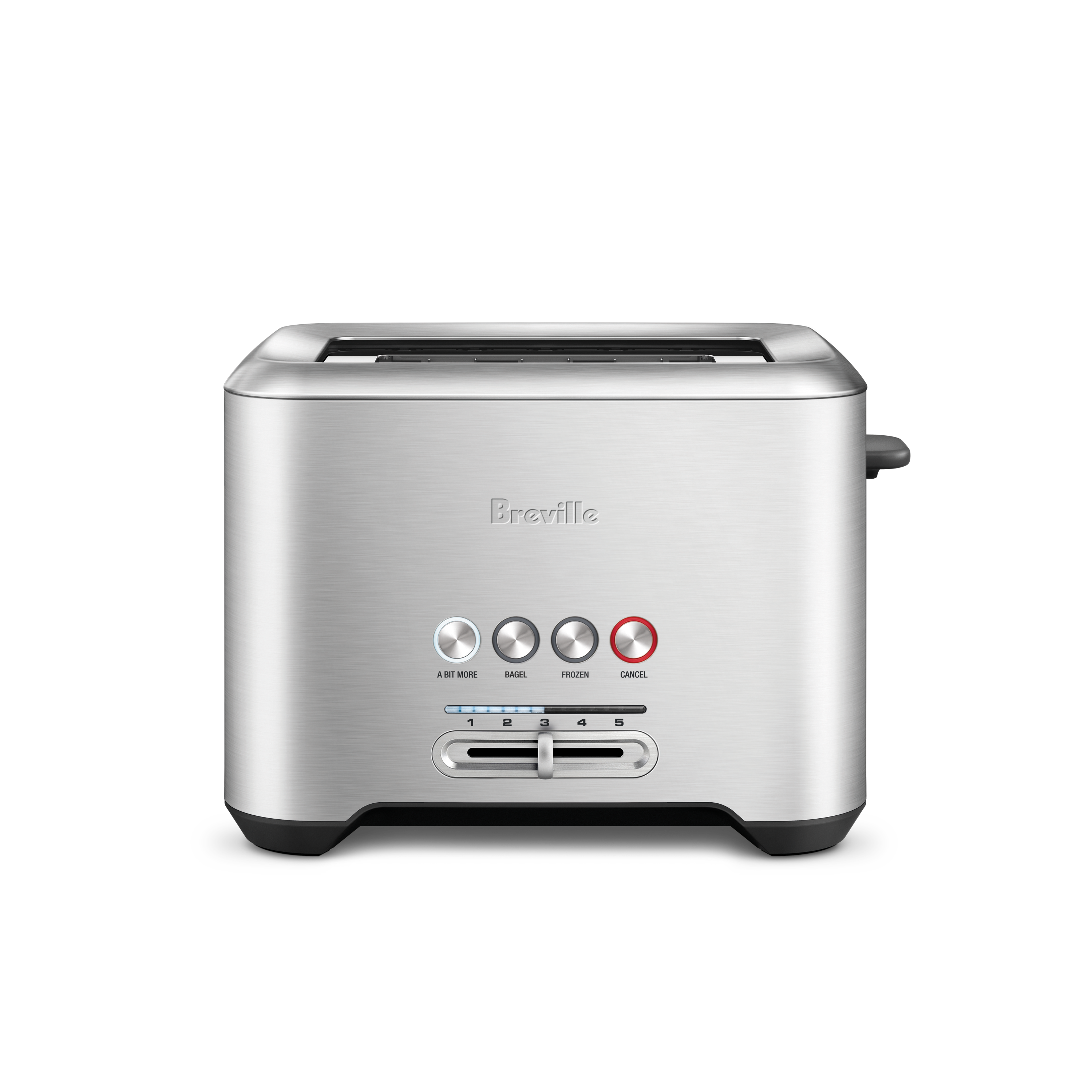
The front uses a slider marked from 1 through 5 and an LED progress indicator. There is a count discrepancy worth keeping visible: Breville's product-page specification says “5 Settings,” while its instruction book describes 12 browning settings across the 1-to-5 scale. The sources do not clarify whether they count different aspects of the same control, so this review does not use an exact shade-step count as a comparative fact or finder requirement. The page also lists Bagel, Frozen, Lift and Look, Cancel and A Bit More controls. In the instruction book, Bagel mode is for a cut bagel and asks you to orient the cut face inward; Frozen increases the toasting time for frozen bread. Lift and Look lets you raise the carriage briefly to inspect a cycle, while A Bit More adds toasting time when the first pass is too light. Those are meaningful conveniences for households that often change between fresh toast, frozen bread and bagels. They are not six independent slots or a substitute for choosing a lower or higher shade setting based on the bread. The useful tradeoff is the controls' specificity. Someone who wants a simple lever and dial may not value dedicated buttons and a progress display enough to justify a more involved panel. Conversely, the display makes progress visible, and the additional-time button avoids treating a slightly pale slice as a reason to restart with a whole new cycle. The manual says the toaster can beep, with a volume adjustment; shoppers who need a completely silent appliance should not infer that a quieter alert eliminates the sound of the carriage or toaster itself.Measure the body, then check the usable space
Breville lists the body at 8.2 inches wide by 11.3 inches deep by 7.3 inches high. Use those as the appliance's published outside dimensions, not as its required operating-space envelope. Before deciding, check the manual's clearances and your own access: the plug must reach safely, the front crumb tray needs room to slide out, the toaster should sit on a stable counter, and nearby cabinets must not interfere with loading or lifting toast. A footprint can look compact in a photograph while leaving an awkward route to the outlet or tray. The product page lists 900 watts at 120 V, 60 Hz. That identifies the reviewed US electrical version; it is not a performance score or a promise about cycle time. Do not substitute specifications for an overseas BTA720 edition: the model suffix and electrical plate matter. The US page identifies the brushed-stainless BTA720XL SKU and lists a one-year limited warranty. Confirm the exact suffix, seller, warranty jurisdiction and return terms on the offer you are considering.Cleaning and safe jam handling matter
The sliding crumb tray is a practical feature only if it remains accessible and is emptied regularly. Breville's manual says to unplug the toaster and let it cool before cleaning, to replace the tray before using the machine, and not to operate it without the tray in place. It warns that accumulated crumbs can create a fire hazard. If an item jams, the manual says to disconnect power and wait for the appliance to cool before carefully easing it out; it specifically warns against metal utensils. These instructions are more decision-relevant than an unsupported promise that any toaster is easy to clean.Who should compare it with something else?
This model deserves a closer look if your routine is two slices or fewer, includes frozen bread or bagels, and you would use the progress display or Lift and Look feature. Its main drawback is not hidden: it cannot toast four slices in one cycle. If household pace matters more than a two-slice footprint, compare four-slice and long-slot arrangements, while checking whether their slots give you the bread geometry you need. If width or cabinet clearance is tight, measure the full counter setup before shopping. The word “review” here means a source-based assessment of the named US configuration—not a lab result, owner report, or ranking among the full toaster market. This is one of two resolved model assessments in an unfinished category inventory, not a category-wide recommendation.Key specifications
Key details at a glance
| Capacity | 2 slices per cycle |
|---|---|
| Body width | 8.2 in |
| Body depth | 11.3 in |
| Body height | 7.3 in |
| Listed power | 900 W |
| Supply voltage | 120 V |
| Line frequency | 60 Hz |
| Shade control | Numbered scale marked 1–5; exact selectable-step count unresolved because the product page lists ‘5 Settings’ while the instruction book describes 12 browning settings across 1–5. |
Use the exact model’s instructions for operating limits, supplied equipment and version differences.
Sources for this review
Sources for this assessment
Compare the routine, not just the control panel.
Use the finder for combinations of capacity, features and counter limits, then check each exact model's review and instructions.